more info soon…
The project …re-writing the self – reflection on the move… is supported using public funding by the National Lottery through Arts Council England.
Artist
more info soon…
The project …re-writing the self – reflection on the move… is supported using public funding by the National Lottery through Arts Council England.
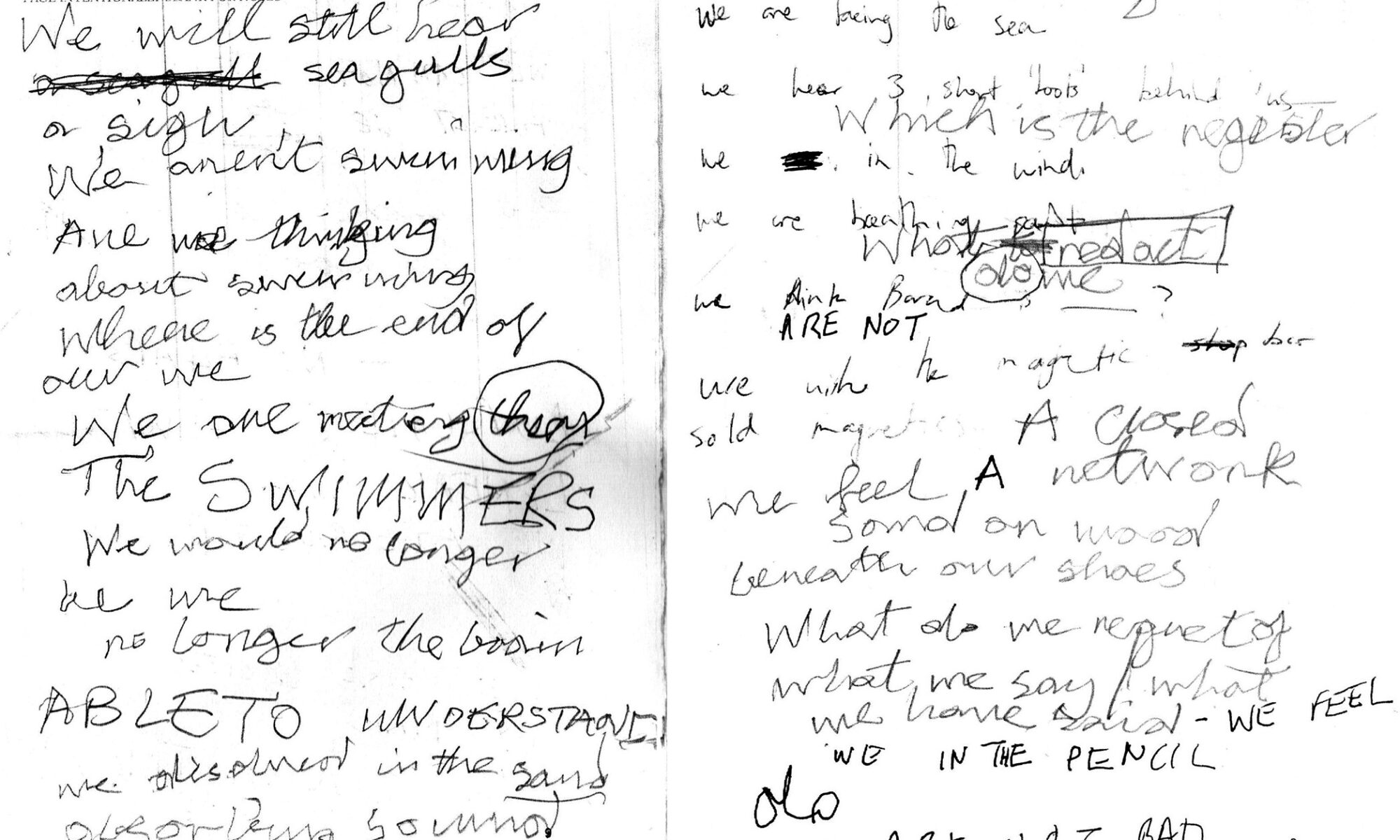
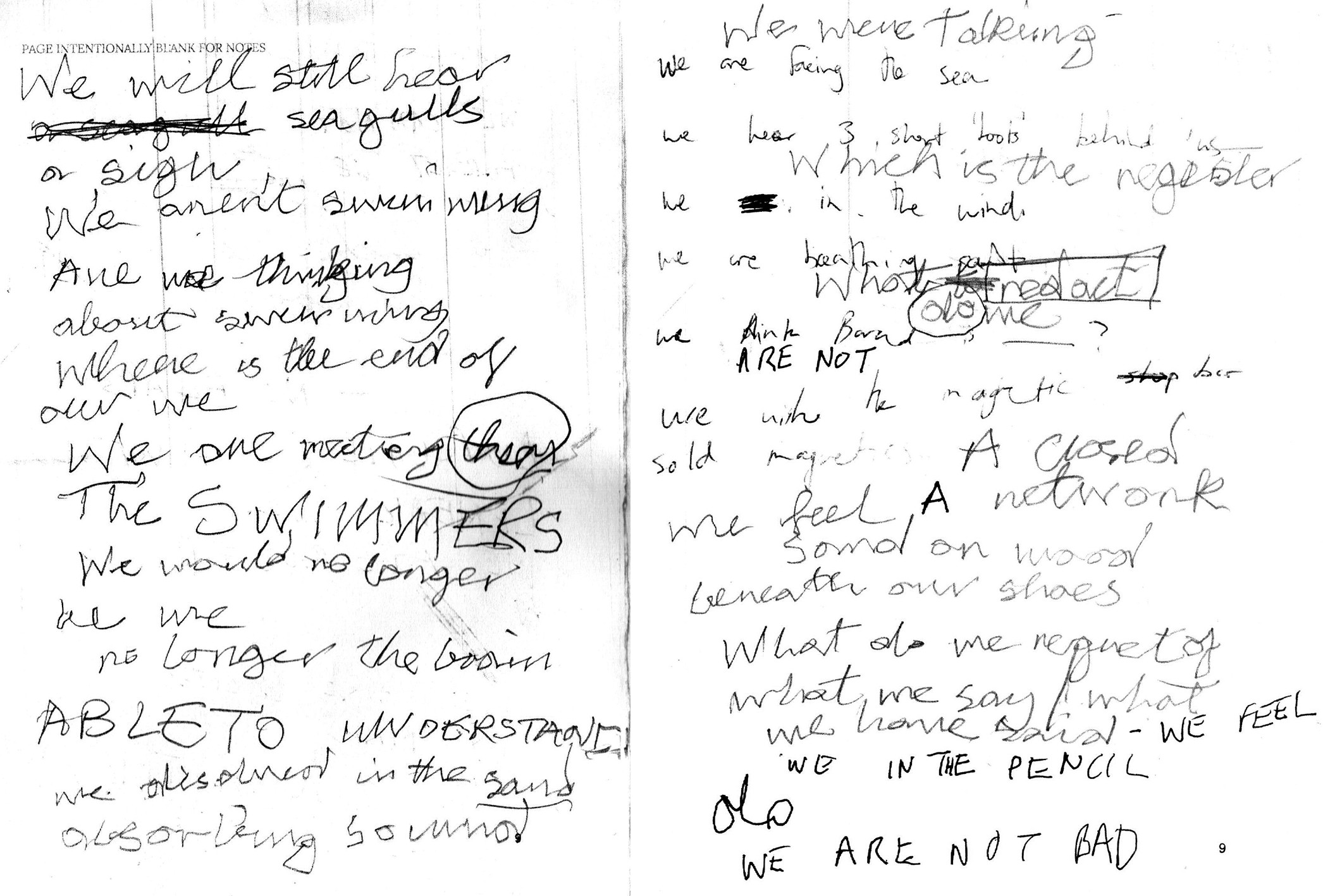
Walking Questions workbook pages, 2026.
Walking Questions was a walking workshop developed by Benjamin Jenner and Ian Bottle for Listening Grounds II.
Listening Grounds
Listening Grounds was a two-part site-responsive collaboration between The Margate School of Art (TMS), Margate, United Kingdom and the École Supérieure d’Art Dunkerque (Esä), Dunkirk, France. Led by Amias Hanley and Melissa Ryke, the workshop brought together undergraduate and postgraduate Fine Art students and staff from both institutions to work collectively across coastal sites on either side of the English Channel.
In December 2025, participants from TMS of Art travelled by ferry across the English Channel to Dunkirk, where they joined students and staff at Esä to undertake site-responsive listening work at the Leffrinckoucke bunkers situated in the Dewulf Dune Nature Reserve and surrounding coastal landscape.
Two months later, students and staff from Esä Dunkirk made the return crossing to Margate, continuing this shared enquiry through fieldwork at the Denge Sound Mirrors in Lade Pits, part of the RSPB Dungeness Nature Reserve, and across sites along the Kent coastline. Moving between these locations, Listening Grounds unfolded as a transnational encounter into listening as a situated, embodied, and infrastructural practice.
Walking Questions
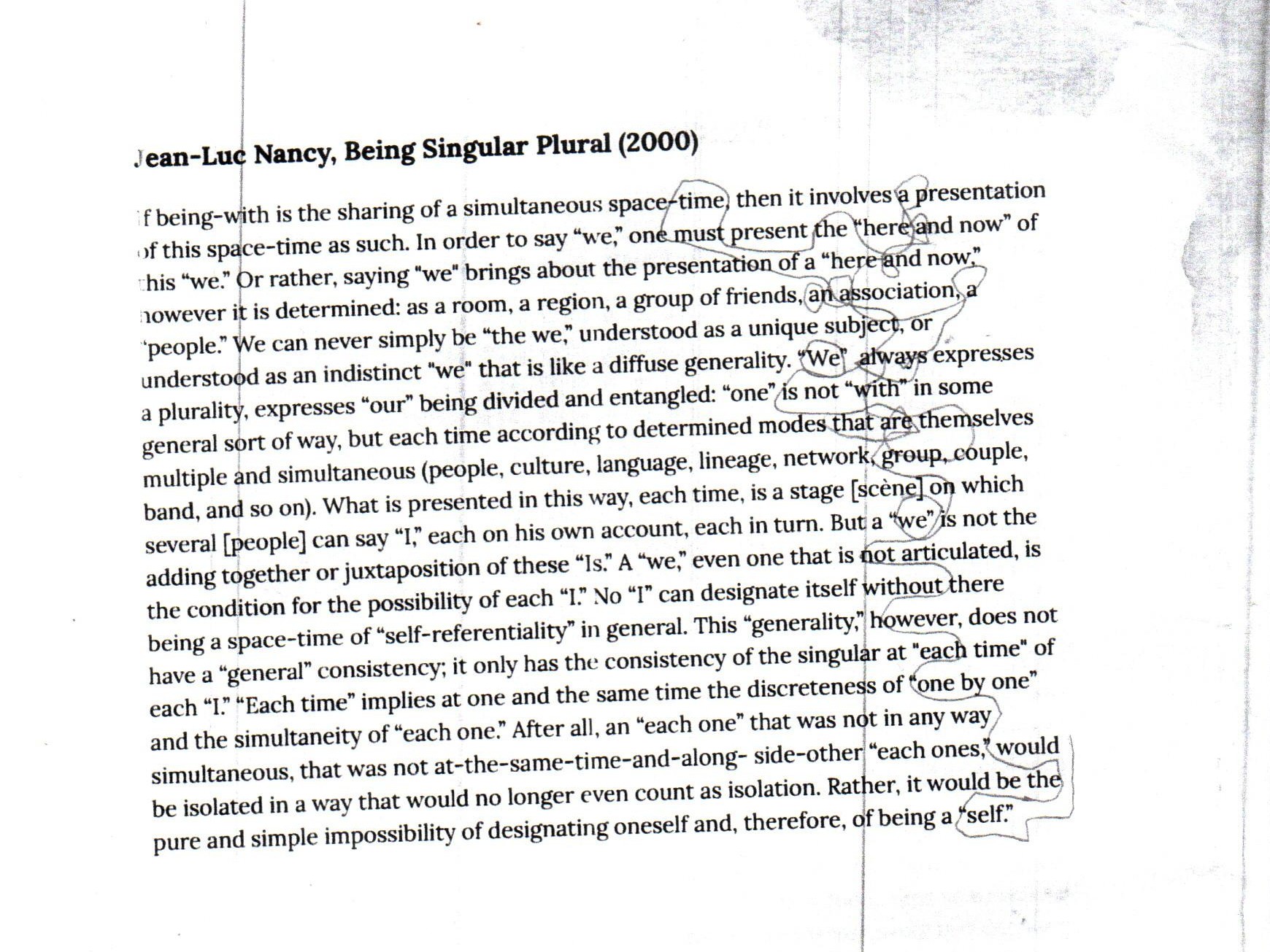
Jean-Luc Nancy, Being Singular Plural workshop extract with notation marks.
Walking Questions took place on 9 February 2026 between the hours of 14:30 – 16:30 in Broadstairs, Southeast Kent. Working with the idea of listening as a embodied, situated practice, the workshop asked how the act of listening might be distributed amongst multiple bodies, inviting consideration of the complexity of experience, the subtlety of interpretation, and the limitation of language to fill this perceptual gap.
Working with a short extract from Jean-Luc Nancy’s Being Singular Plural (available above), participants were asked to explore the town of Broadstairs in groups, discussing their experience as they went using the first person plural pronoun “we”. Observations on the experience were recorded in workbooks by way of keywords. As the walk progressed, workbooks were exchanged between group members facilitating the recycling of words for further discussion and the redaction, repetition and annotation of words in the workbook in line with new or nuanced interpretations of the experience. How, the workshop asked, is listening facilitated and/or prevented by distributing responsibility for its implications; how is that responsibility represented in/on/through the inscription of words that mark positions and order (constrain?) their affects? The workbook pages form the visual backdrop to the short essay Walking Questions that is available in both English and French in the Listening Grounds publication (pp. 38-49), below.
Listening Grounds publication
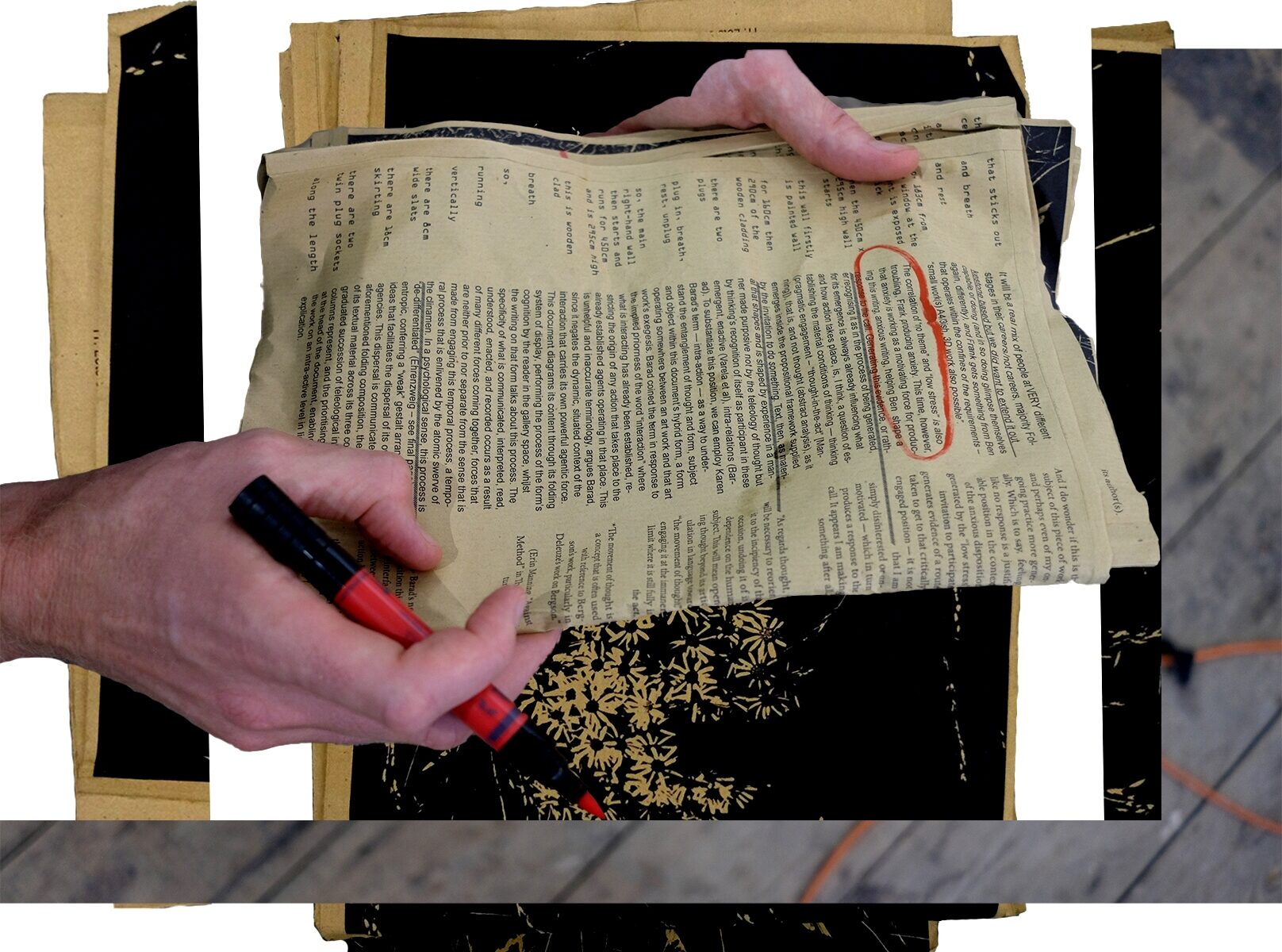
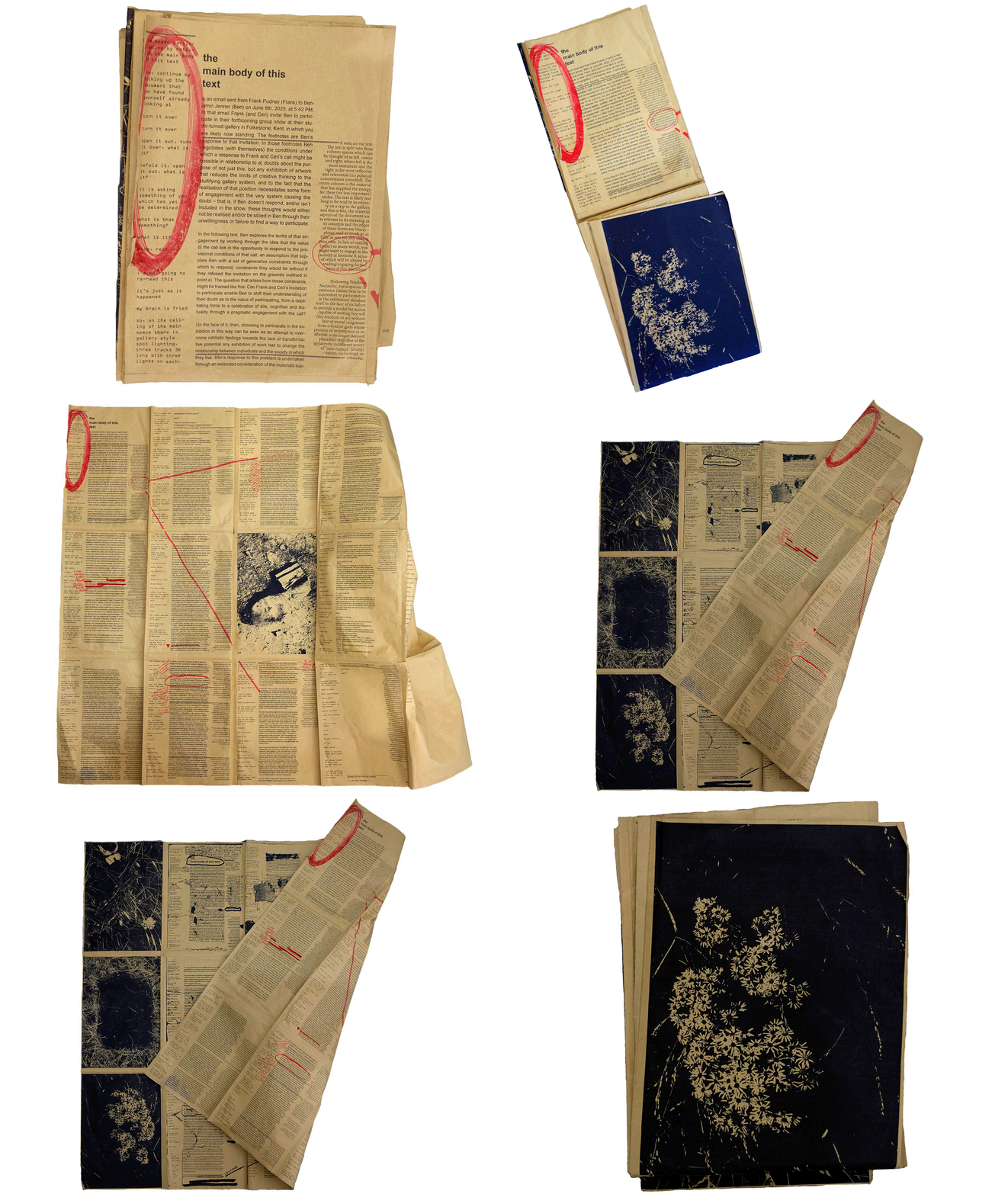
the main body of this text, exhibited at Dover Road Gallery, Folkestone, Kent between 02nd and 10th August 2025.
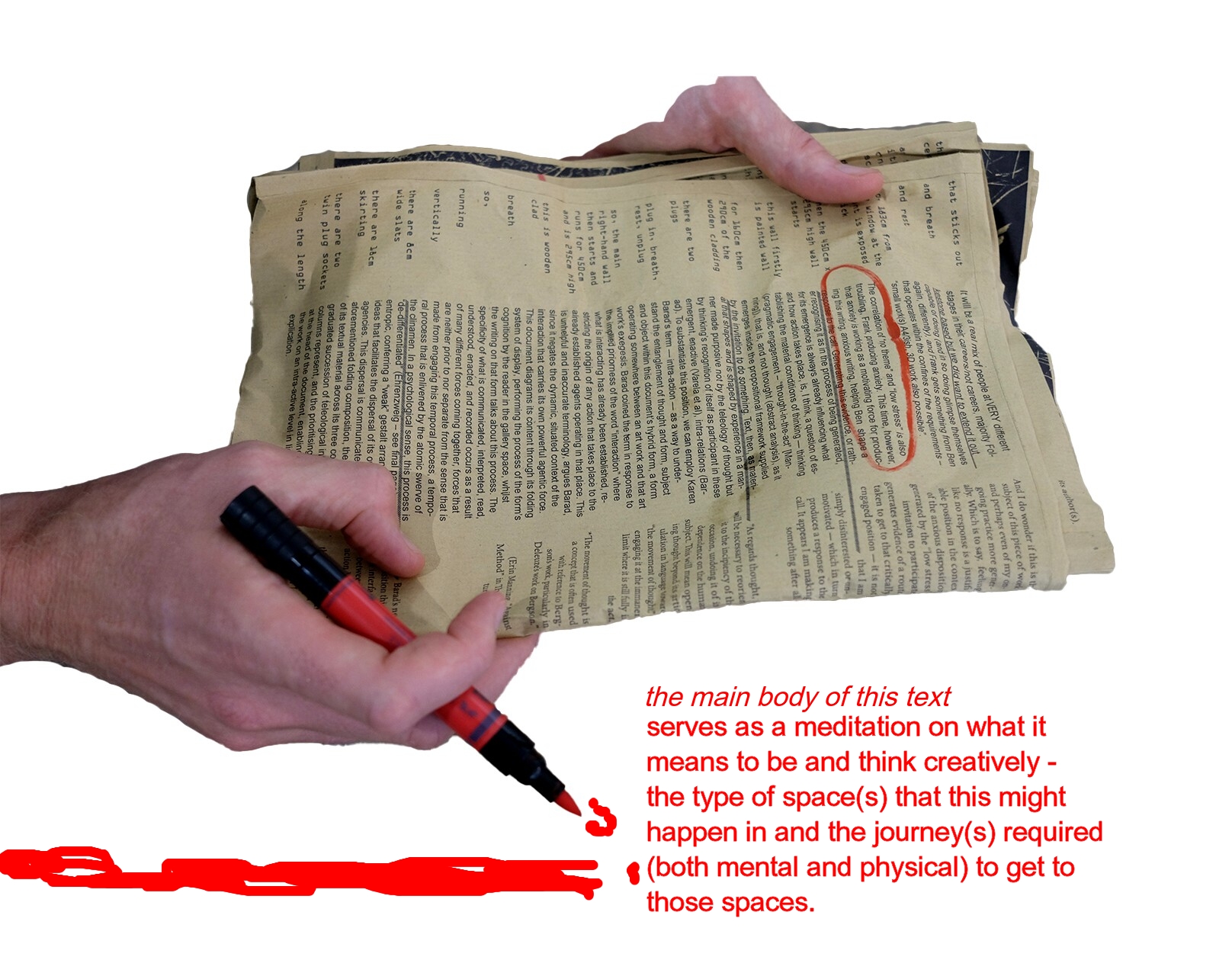
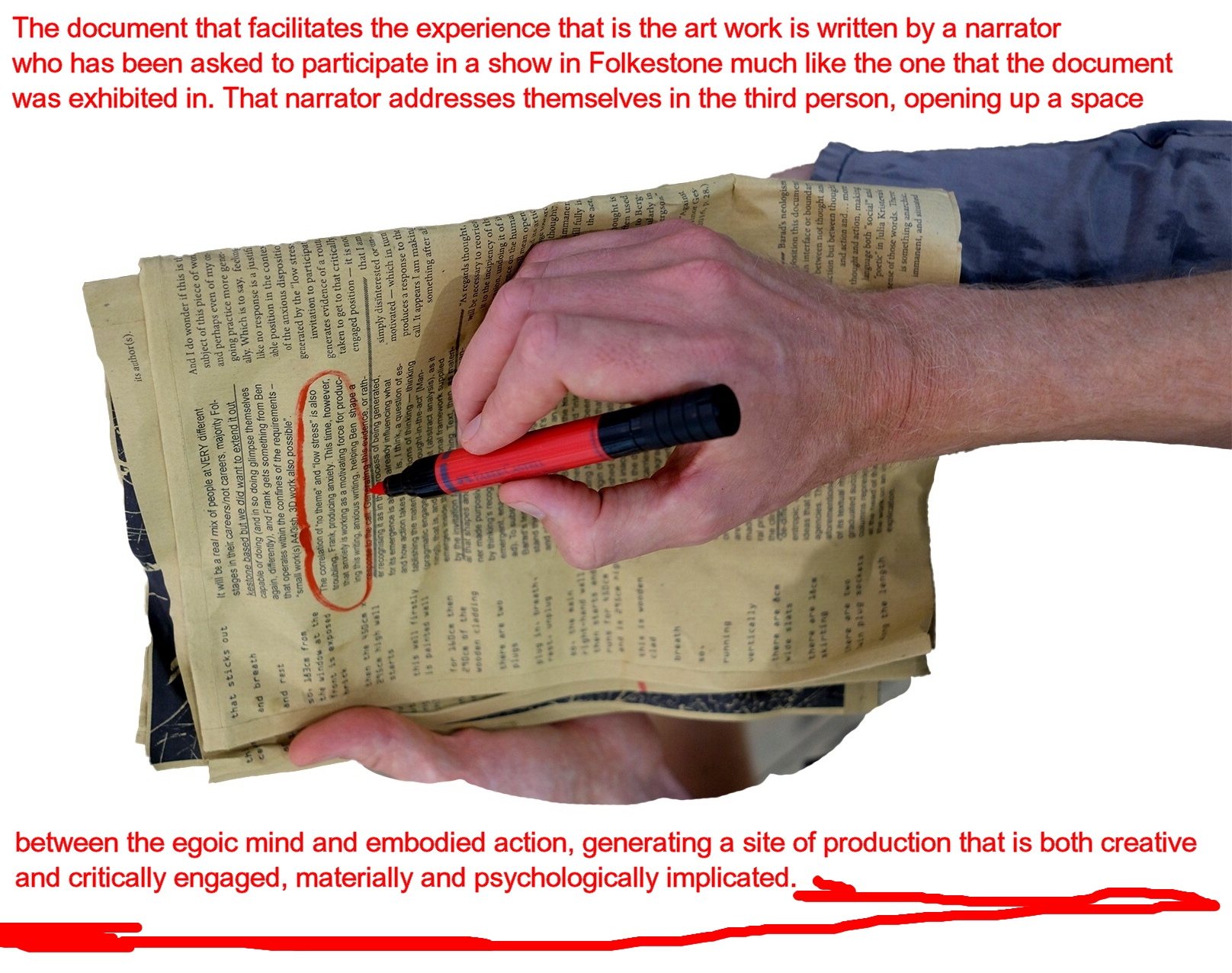
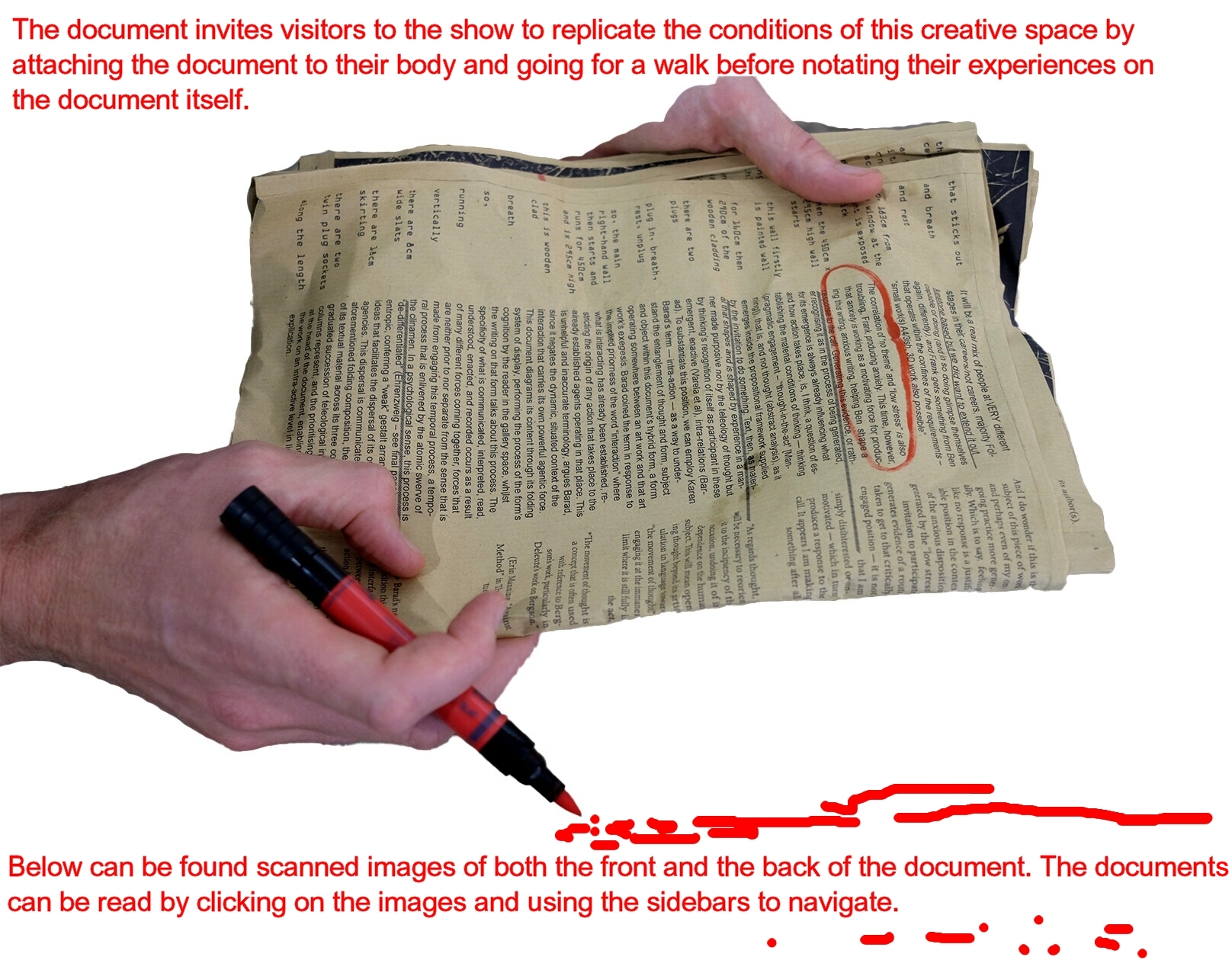
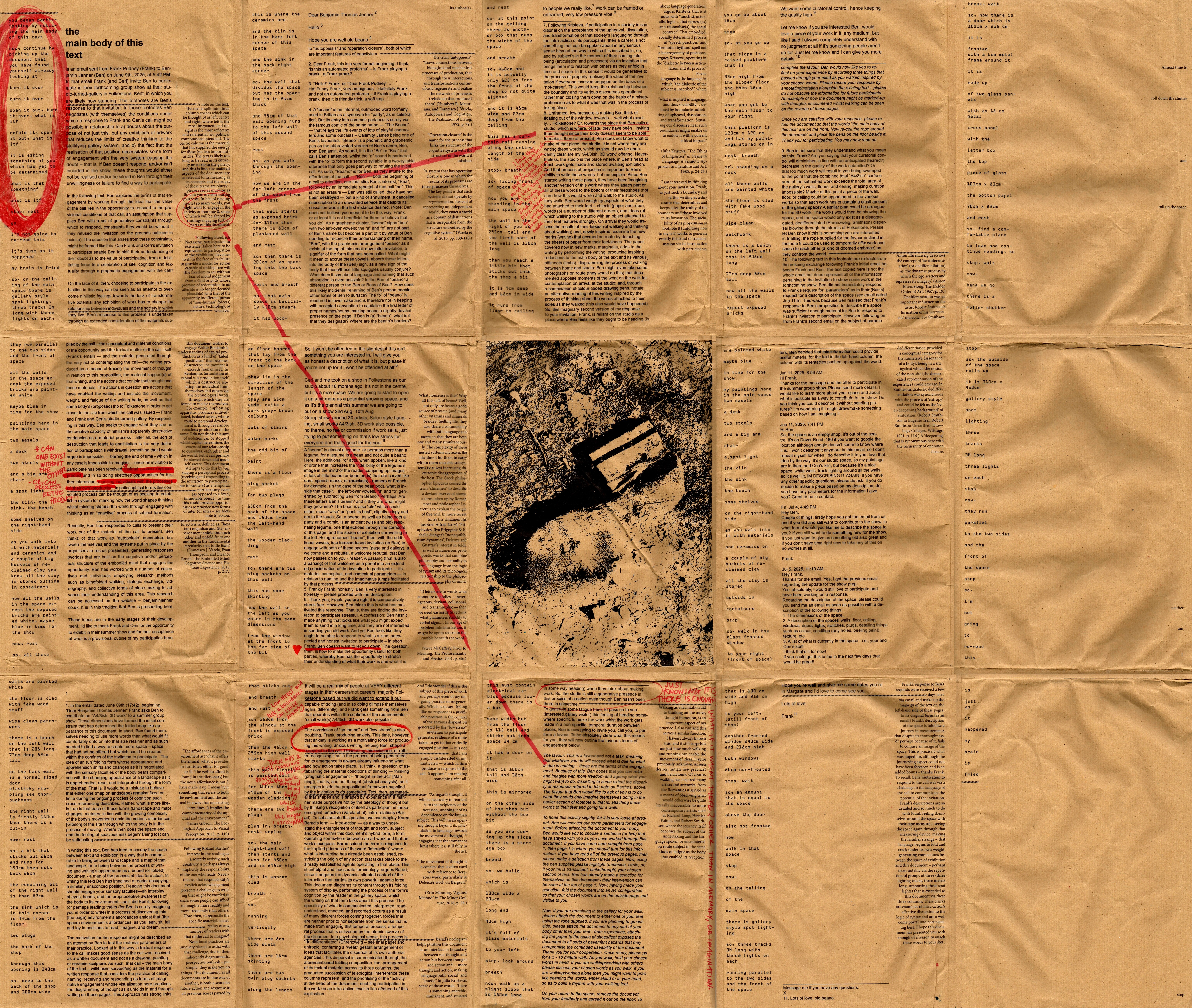
the main body of this text – front
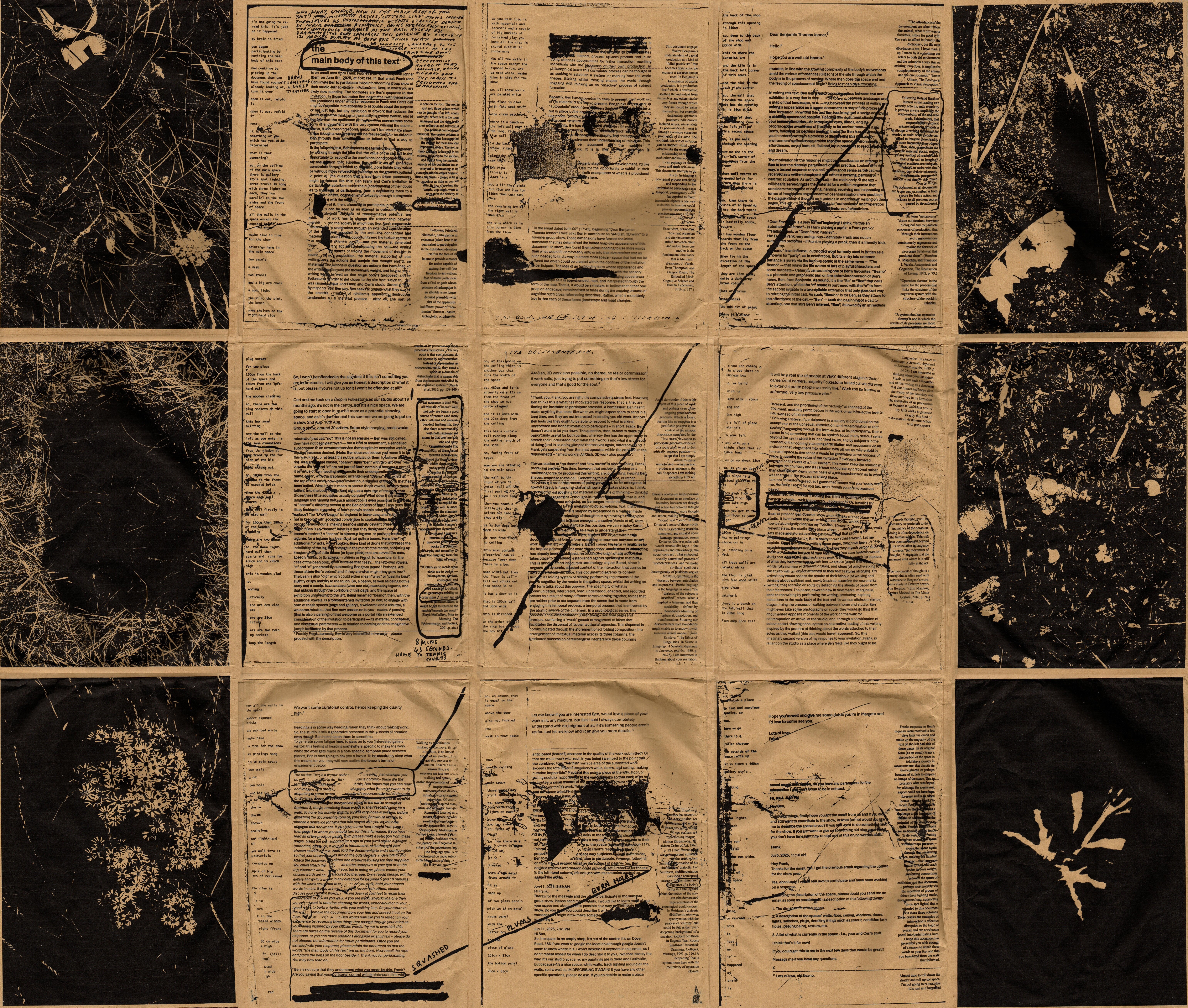
the main body of this text – back

A collaborative research project with Words as Matter, a Special Interest Group (SIG) of the Language-Based Artistic Research Group. The research was shared as part of the 16th Society of Artistic Research gathering in Porto, Portugal in May 2025:
Words as Matter // Mariana Renthel | Erika Tsimbrovsky | Cecilie Fang Jensen | Benjamin Jenner | Danica Maier | Antrianna Moutoula | Anouk Hoogendoorn

An example of Anouk Hoogendoorn’s letters to group members of Words as Matter
During May 2024, Anouk wrote letters to the members of Words as Matter in a park, guided by the wind in an open collaboration with the air’s uncanny currents. These traces, shaped by movement and chance, became messages to the members of the group: Mariana, Erika, Cecilie, Benjamin, Danica, Antrianna.
For research purposes, with a playful and creative approach, the group responded with videos, echoing the interplay between intention and elemental forces. This asemic exchange reimagined writing as a dialogue beyond human language. The wind, as co-author, left its mark alongside Anouk’s gestures, while the videos extended the conversation into new mediums and other entities.
As an open experiment, one might invite a force—light, water, sound—to shape letters, filming the process as it unfolds. The group’s video contribution to the above conference can be viewed here: https://www.researchcatalogue.net/view/835089/3594677
i was going to do it…
My contribution to the group video work, entitled i was going to do it…, was motivated by the practice of conceptual art group Collective Actions (CA), and in particular their idea of the ’empty action’: an intervention into a constructed situation that alters participant’s understanding of their role in the unfolding experience. The empty action involves a shift in participant’s understanding of the value of what is being observed and/or happening around them, whereby what was understood to be preamble or preparation (what CA call “extra-demonstrable information”) is suddenly understood (retrospectively now) to have been the main event (what CA call “demonstrable information”). Crucial to the success or failure of the empty action is the ability of group members to place extra-demonstrable elements inside the demonstrable elements without participants suspecting what is taking place ahead of time. The shift in understanding (the transformation of the innocuous into an aesthetic experience) is initiated from inside the (as yet unperceivable) event via the insertion of a normally unremarkable and anti-sensational gesture (such as the signing of a certificate to confirm participation in the event that has just taken place).
The value of the empty action to the creation of an asemic text is in the way it legitimises the possibility of writing with a force in the absence of any understanding that this is what is taking place. That is, it offers the opportunity to write with a force from within the force, to communicate something that is suspended between two types of meaning (my meaning and the meaning brought by the force), without falling into the trap laid by thinking: namely that treating writing as a series of signs for what has been thought after the fact, erases (through the very act of thinking the force) the force and its ‘asemic’ agency.
i was going to do it… Benjamin Jenner, 2025
In i was going to do it… (above) two figures enter a wooded area armed with two pieces of paper, some pens and a camera. They are going for a walk and to have a conversation. Both pieces of paper have the words “cloud, reverse, shutter, light, step, bank, camera, mud” written down the right-hand side; followed by a number from 1 – 9 (see below). In the work, these words operate as signals prompting a period of reflection that includes recalling and writing down the dialogue that led up to the utterance of the word. The aim of the activity is to insert these words into conversation in such a way as to surprise the interlocutor, causing them to reevaluate the purposiveness of the dialogue that lead up to the utterance of the word.

Example of pages used in i was going to do it…
The placement of a signal word by one of the figures inside the dialogue is conceived here as equivalent to the placement of an extra-demonstrable element inside the demonstrable structure of the work. Although both figures are privy to the list of words, placing the words into a sentence that is consistent with the ensuing dialogue takes considerable mental effort, making it less likely that either figure would notice the effort being made by the other to structure the conversation around one of the words. In this way, words that ought to be in thought are able to bypass consciousness with ease on the pretence that they are insignificant (extra-demonstrational) elements of the exchange, a bit like a Trojan Horse rolling unnoticed inside the walls (consciousness) of Troy. Several times during the making of i was going to do it… a signal word was spoken only for the receiver of that word to continue walking, needing to be called back so as to engage in the process of recording and reflection.
The recording of the word’s utterance is undertaken by both figures simultaneously, with each figure writing twice, with both hands (the right hands of both figures write on one piece of paper, the left hands of both on the other) the dialogue that lead up to the word’s utterance. Recalling this dialogue is not a simple task: coupled with the above reference to the fall of Troy as a metaphor for the breaching of thought’s teleology, the dialogue was by definition unremarkable, unmemorable and in no way building up to a significant moment – prior, that is, to the signal words utterance. As such, retrieving the words that make up the dialogue requires a reversal of thought in reference to the loci of the signal word that now (understood as such) reshapes the build up to its utterance. The reshaping of the passage of thought in light of a constructive misapprehension of what has just taken place relinquishes thought’s agency over action, and the agential actions of other forces, generating asemic writing. CA call this kind of document “factographical discourse”. The recording is concluded by each figure attempting to read what the other has written, a process that extends (and is an extension of) the illegibility of much of what has been recorded, itself evidence of the writing-with that occurred prior to the utterance of the word, prior to the realisation that something extra-demonstrable had pierced the surface of the work’s demonstrable elements.

Factographical Discourse: the two sheets of paper as they appear in the video work i was going to do it…
What the force is that the figures are writing with in this instance is not straight forward: is it the presence of an interlocutor (prior to any engagement with the words) whose attention is in a dance with the other figure’s attention [the appearance of which is half constructed sentences and conversational dead ends] (yes); the landscape that enabled the sentence to be languaged (yes) itself a kind of attention; the idea of the word on the page that is contextualised and made immanent and specific through its utterance (yes); and/or the structure of the work/game itself (yes)?
As the number of words available to cite decreases, the absurdity of the task increases and the placement of the extra-demonstrable inside the demonstrable becomes harder to achieve.
With thanks to Colin Goodwin.

A collaborative research project with artist Louise Adkins
Adkins and Jenner come together to ask questions of each other’s understanding of the limits of language and its interface with site, materiality and gesture. Their shared interest in scripting everyday exchanges between people, objects and the world has provided a platform to interrogate alternative routes to knowledge – how know-how can be written out of and into words. Such observations, they have discovered, require a type of time that is hard to come by. As a result, their time together orbits around strategies for implementing slowness in observation – a temporality that resonates with expanded forms of embodied drawing.
Adkins and Jenner met whilst studying on the PhD program at the University of Leeds. In 2022 they founded Reading and Writing Bodies in Space (RWBS), a group of artists, writers, and researchers that convene around re-cognising the bodies relationship to knowledge through crip theory and disability studies. In spring 2024 RWBS facilitated Practice Notes #1 at The Project Space, University of Leeds. In autumn 2024 Adkins and Jenner completed Drawing as Slow Conversation at the Writers’ Room in London.
A Slow Conversation publication, created to mark the completion of The Writers’ Room residency. The booklet interweaves text and material based conversations developed throughout the residency contextualised in relation to process philosophy.
This short ‘sketch for a play’ dramatises a number of the intertextual relationships that emerged throughout the residency.


Lin[e]guistic Diagrams: Scripting the Workshop from beyond the Visual was presented at the conference Drawing Across X Along X Between University Borders organised by i2ADS and the DRAWinU group and hosted by the University of Porto, Portugal, on the 16th, 17th, and 18th of October 2024.
“Benjamin Jenner’s research proposes that drawing-as-process can serve as a “second language” to critique and restructure conventional textual analysis. His work focuses on the concept of “lin[e]guistic diagrams,” which are created through the physical enactment of a workshop script. Drawing on Pamela M. Lee’s temporal triad — the entropic, transitive, and contingent — Jenner treats drawing not as a static visual record, but as a fluid, temporal process that actively destabilises the referential primacy of language. The word-drawings function as a graphemic second language that facilitates interdisciplinary exchange by engaging the recursive relationship between text and material reality.”
Introduction to the DRAWING ACROSS X ALONG X BETWEEN UNIVERSITY BORDERS – Approaches to Drawing Research Across Disciplines
LIN[E]GUISTIC DIAGRAMS: SCRIPTING THE WORKSHOP FROM BEYOND THE VISUAL was a workshop delivered at Drawing Across X Along X Between University Borders organised by i2ADS and the DRAWinU group and hosted by the University of Porto, Portugal, on the 16th, 17th, and 18th of October 2024.
Building on previous work, such as Walking Between Wor[l]ds with Lines, and Blindfolded Feedback, the workshop sought to employ the conference proposal as a prompt to diagram the workshop (the space, the people in the space, the objects in the space) as it/they unfolded in real time through the creation of a script (details below). In doing so, it (the workshop) aimed to show how three key principles of drawing-as-process – the entropic, the transitive, and the contingent (Pamela M Lee) — can be employed to restructure the way language signs for experience.
In undertaking this task, I have approached the workshop proposal as a “proposition”, a proposition that is gradually undermined in the workshop by subjecting its language to Lee’s triad of terms, weakening the imperative of its address.
In the accompanying catalogue essay (https://doi.org/10.34626/i2ADS/2025-0001), I employ the drawings made in the workshop to question the primacy of text. In doing so, I demonstrate how drawing-as-process can operate as a remedial prosthesis, a second language to the words of the proposal, transforming it into an “open work”, a notational arrangement of information, opening channels across x along x between university borders.
Lin[e]guistic Diagrams: Scripting the Workshop from beyond the Visual was presented at the conference Drawing Across X Along X Between University Borders – catalogue essay.
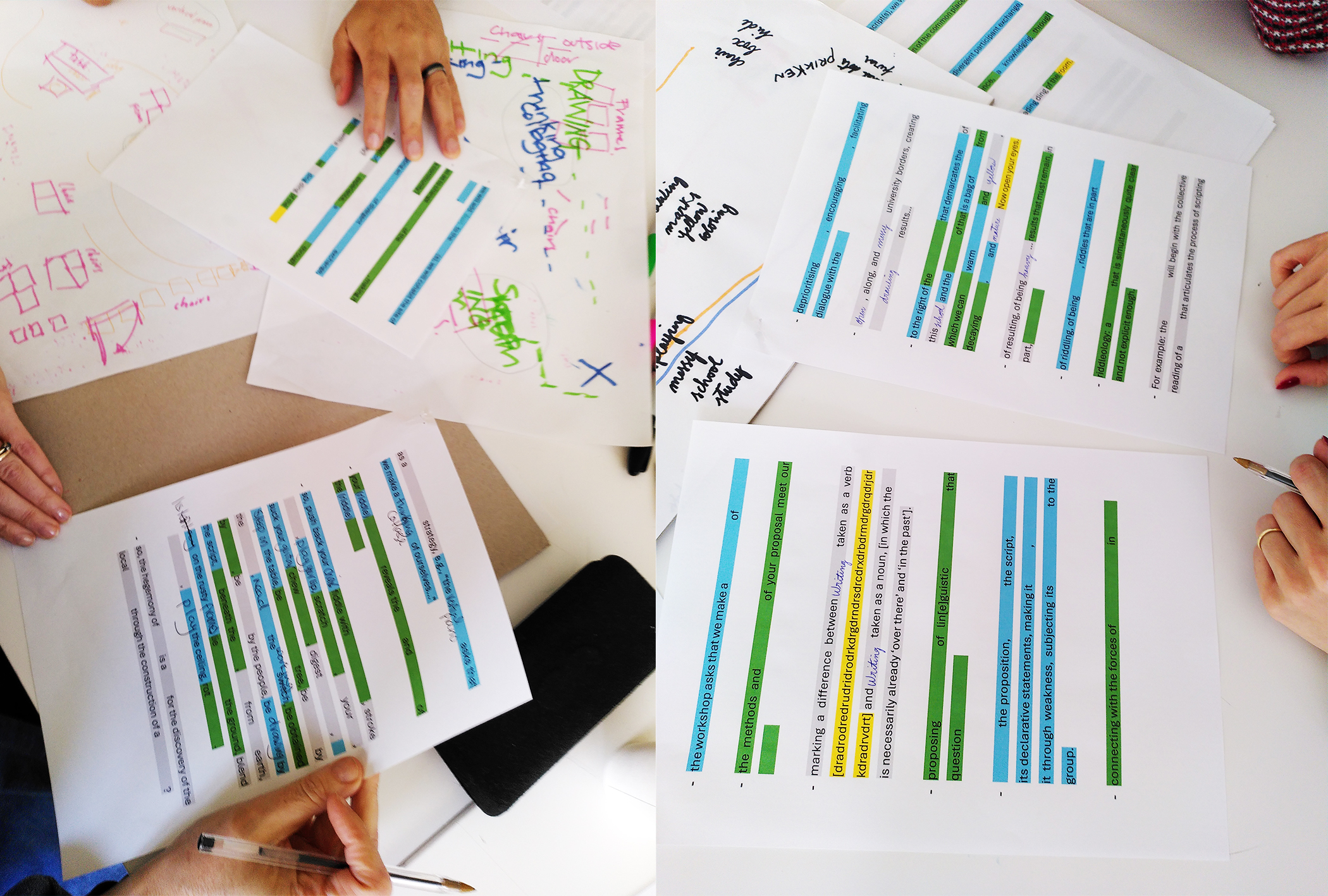
images from the workshop in Porto.
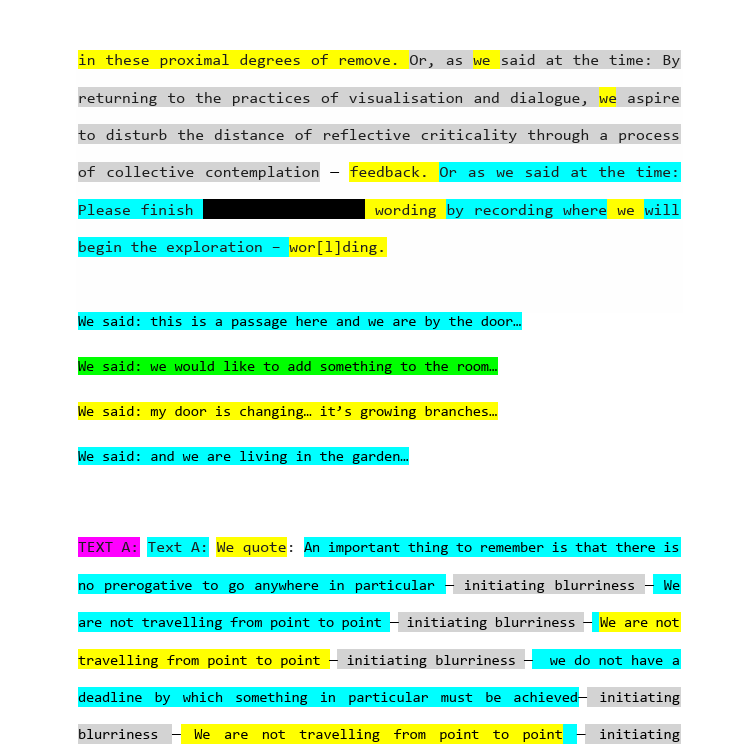
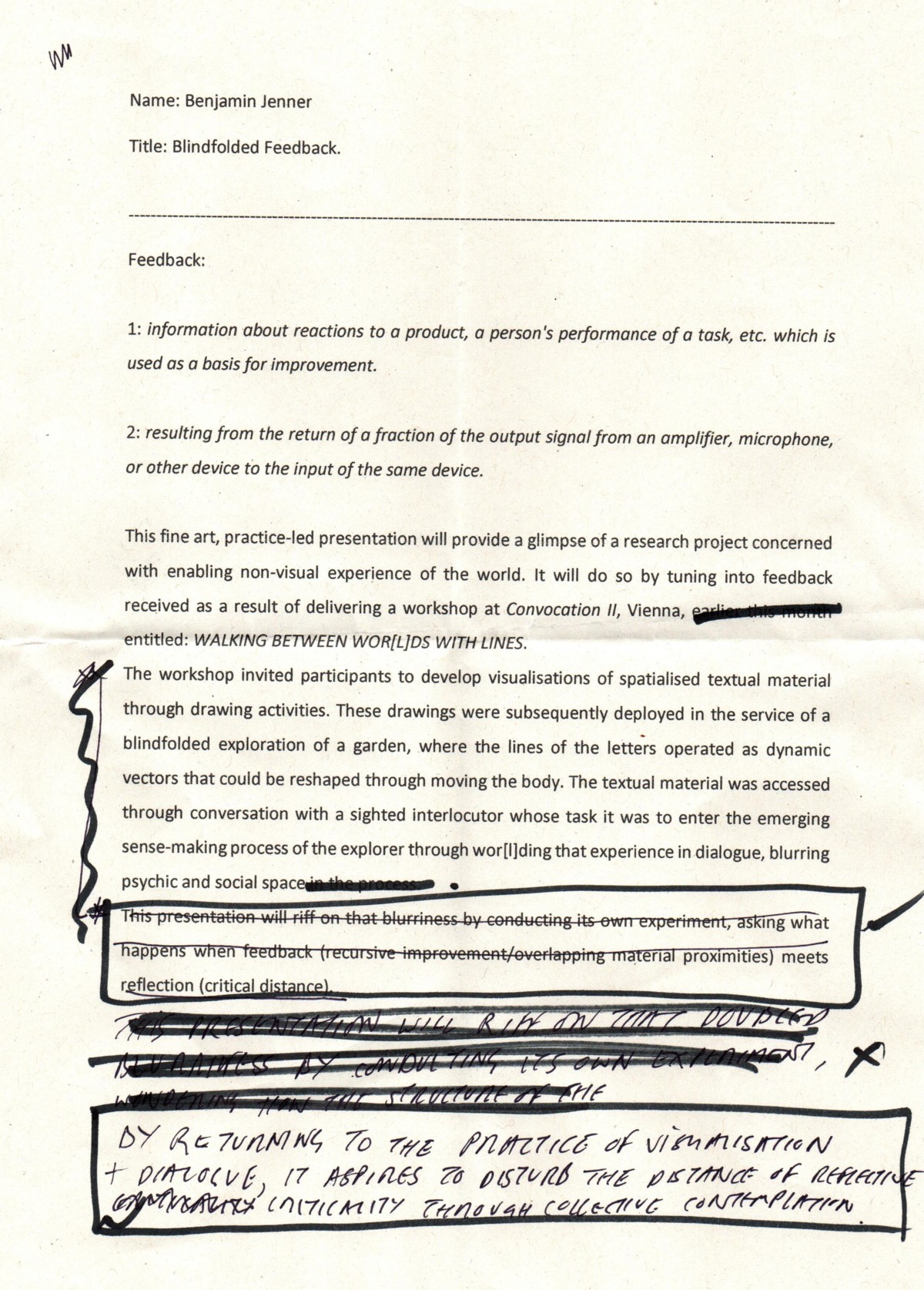
Benjamin Jenner, BLINDFOLDED FEEDBACK, a conference proposal.
BLINDFOLDED FEEDBACK was created in response to the workshop WALKING BETWEEN WOR[L]DS WITH LINES (delivered at Convocation II, October 2023), and is intended as both documentation of that event and a work in its own right. The phrase ‘blindfolded feedback’ was generated in response to the call for ‘additional, unscheduled parallel sessions’ to the timetable during Convocation II. I proposed a feedback session that offered the chance for workshop participants to relay their experience of WALKING BETWEEN WOR[L]DS WITH LINES. However, in the event, no one could attend the allocated time for ‘blindfolded feedback’ due to the (many) other commitments already timetabled into the schedule of Convocation II. Rather than this being a problem, the difficulty of scheduling additional space and time in which the feedback could occur generated thoughts related to the workshop itself, and in particular, the imperative to re-attune to (and by default make space and time for), otherwise overlooked interpretations of the world. This in turn caused me to wonder how feedback is received when it falls outside of the allotted time ascribed to it (for I certainly received it), or the sensory modes attuned to it (for I definitely heard it), and how, by attending to feedback received as such, it might be utilised as material for reflective re-presentation: blindfolded feedback.
To explore these concerns I wrote an application to present at the University of Leeds’ Annual Practice-led PhD Symposium. That proposal can be accessed above.
For the symposium itself, I wrote a script for many voices designed to be performed through collective reading. The script is built around citations from the proposal and the workshop text for WALKING BETWEEN WOR[L]DS WITH LINES (available on the page of that name). By offering the text as a script to be performed by the room (a room whose normative attunement is that of a speaker visualising absence through a PowerPoint presentation), I (we) seek to re-attune to the room through the principles of (un)scheduled embodied, blindfolded feedback.
The script and an accompanying audio recording of the collective reading can be accessed below.
Benjamin Jenner, captioned audio of the collective reading of BLINDFOLDED FEEDBACK.
In editing the audio recording of the collective reading, I have chosen to include the ‘voice’ of the speech to text translation service. This voice extends the interpretive imperative of the workshop WALKING BETWEEN WOR[L]DS WITH LINES by generating a new text, one whose ‘mistranslations’ will likely be utilised in future iterations of this work.
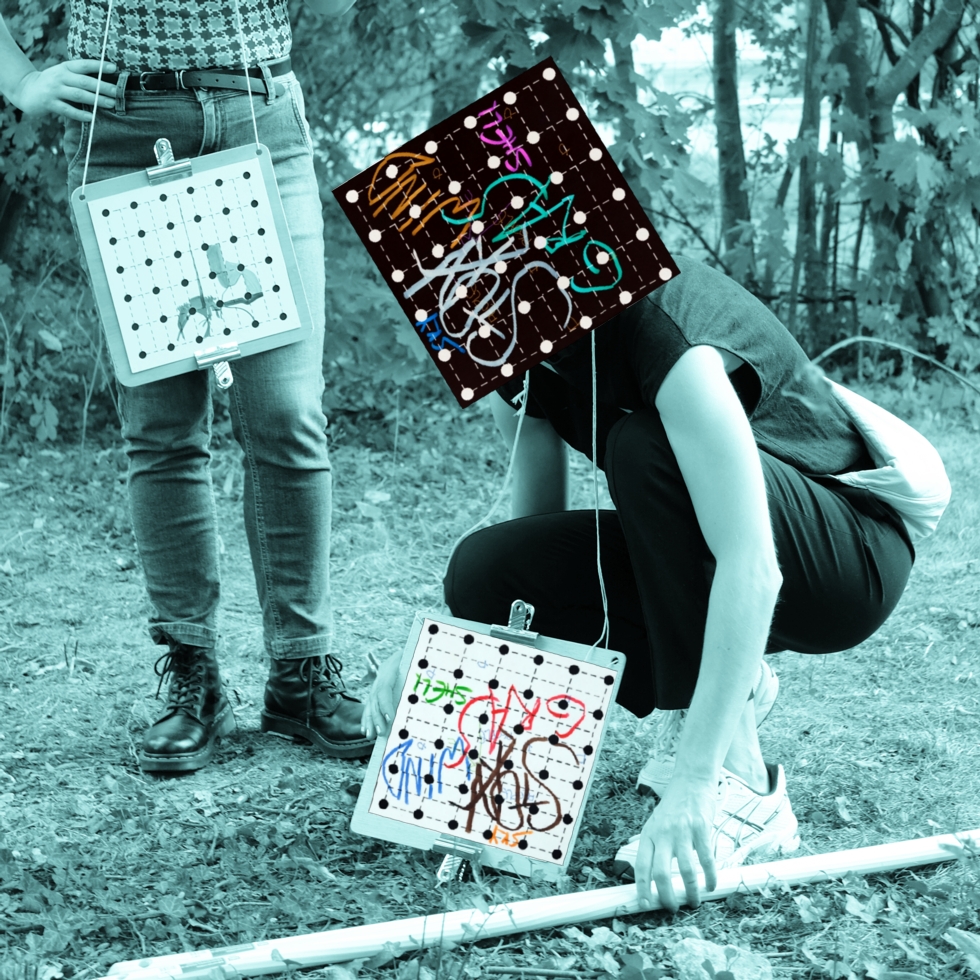
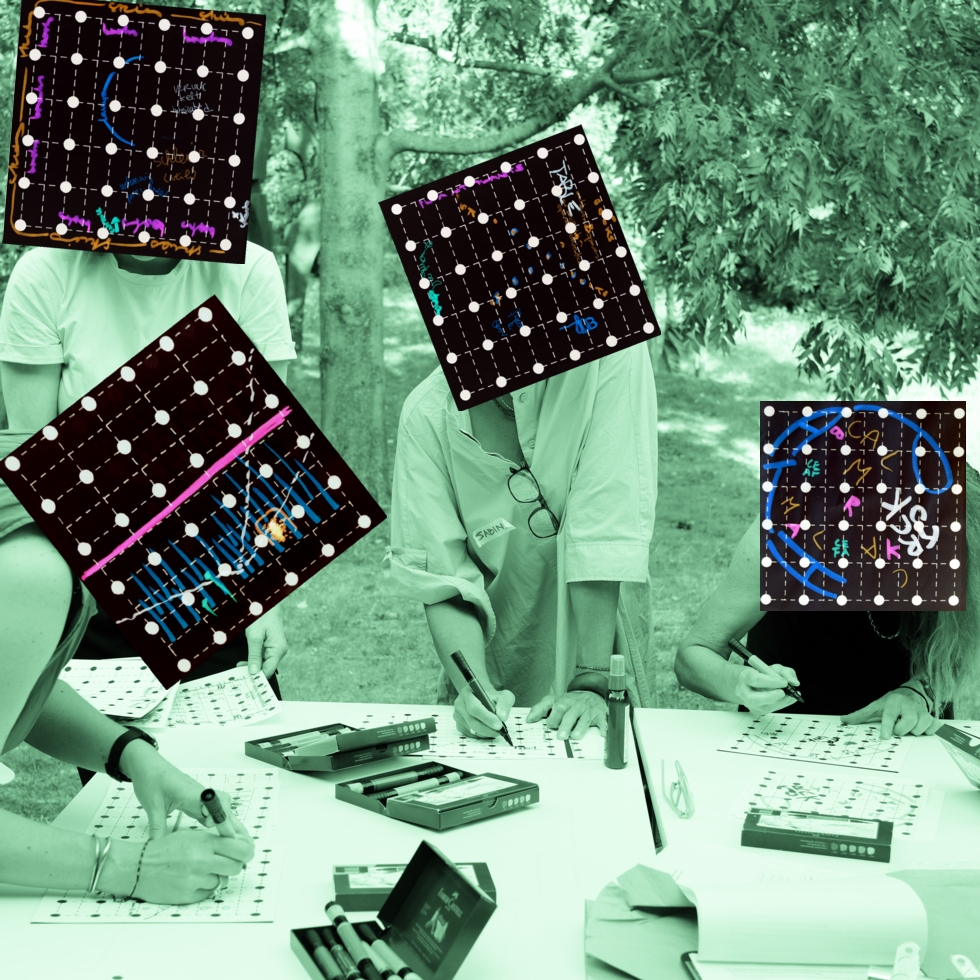
Benjamin Jenner, Walking Between Wor[l]ds with Lines, Convocation II, Language-Based Artistic Research Group, University of Applied Arts, Vienna, 2023.
Walking Between Wor[l]ds with Lines was a participatory workshop delivered at Convocation II, Vienna, in October 2023.
The workshop offered the opportunity to employ self-generated text-based images as tools for exploring a garden space without use of the eyes.
Through a visualisation process, participants were asked to imagine a space of learning that was important to them. By following a series of verbal prompts, that space was gradually transformed in mind into a spatialised arrangement of words. Those words were then translated onto a tactile paper surface as an arrangement of graphic lines, like a form of notation.
In dialogue with a sighted interlocutor the blindfolded explorer then set out into the garden with their drawing. Rather than lead or guide the explorer, the interlocutor’s role was to support the emergence of the explorer’s blindfolded world in language originating in the explorer’s spatialised arrangement of words. As the exploration developed and the relationship between the garden and the visualisation began to get increasingly complex, new words were added onto the drawing by the blindfolded explorer. These new words served to both affirm the presence of the visualised space in the embodied space of the garden – windows merging with trees, tables with bushes, etc – whilst reminding explorer and interlocutor of the mediating function of language. By exploring space in this way, explorer’s practice dissociating experience of familiar spaces from language that delimits and predetermines what those spaces can be. By encountering unfamiliar objects (in the garden) whilst moving through familiar spaces (in the mind), explorers rework the language associated with that space.
Benjamin Jenner, Walking Between Wor[l]ds with Lines, Convocation II, Language-Based Artistic Research Group, University of Applied Arts, Vienna, 2023.
Following the workshop, I developed my workshop text into a digital booklet (available below). This text and its re-presentation is a response to the way that my understanding of the workshop developed through its facilitation. The grey text is the workshop text prepared for Convocation II; the highlighted text was written during the workshop in response to the activity; whilst the redacted text was prepared for the workshop but remained unarticulated. The images that accompany the words have been generated from the tactile grid that participants used to make their drawings. As participants explored the grid blindfolded, that structure’s temporal qualities came to the fore, enabling it to relinquish its modernist associations and blend with the garden. This blending was expressed by the participants in dialogue and through their drawings. It is represented here through the deconstruction of the grid’s formal elements in line with the participant’s discoveries.
Benjamin Jenner, Walking Between Wor[l]ds with Lines: A Workshop Text
This workshop and its ephemera are an extension of my own blindfolded explorations of space. They are intended both as a way of making the work public and of enabling others to practice and extend the processes I have developed through my research. As much as these events (workshop/workshop text) are about engaging tactics for blindfolded exploration, they are also about developing an embodied critique of the relationship between language and vision through deep listening and dialogic intra-action (Barad). This relationship is explored further in the work BLINDFOLDED FEEDBACK.
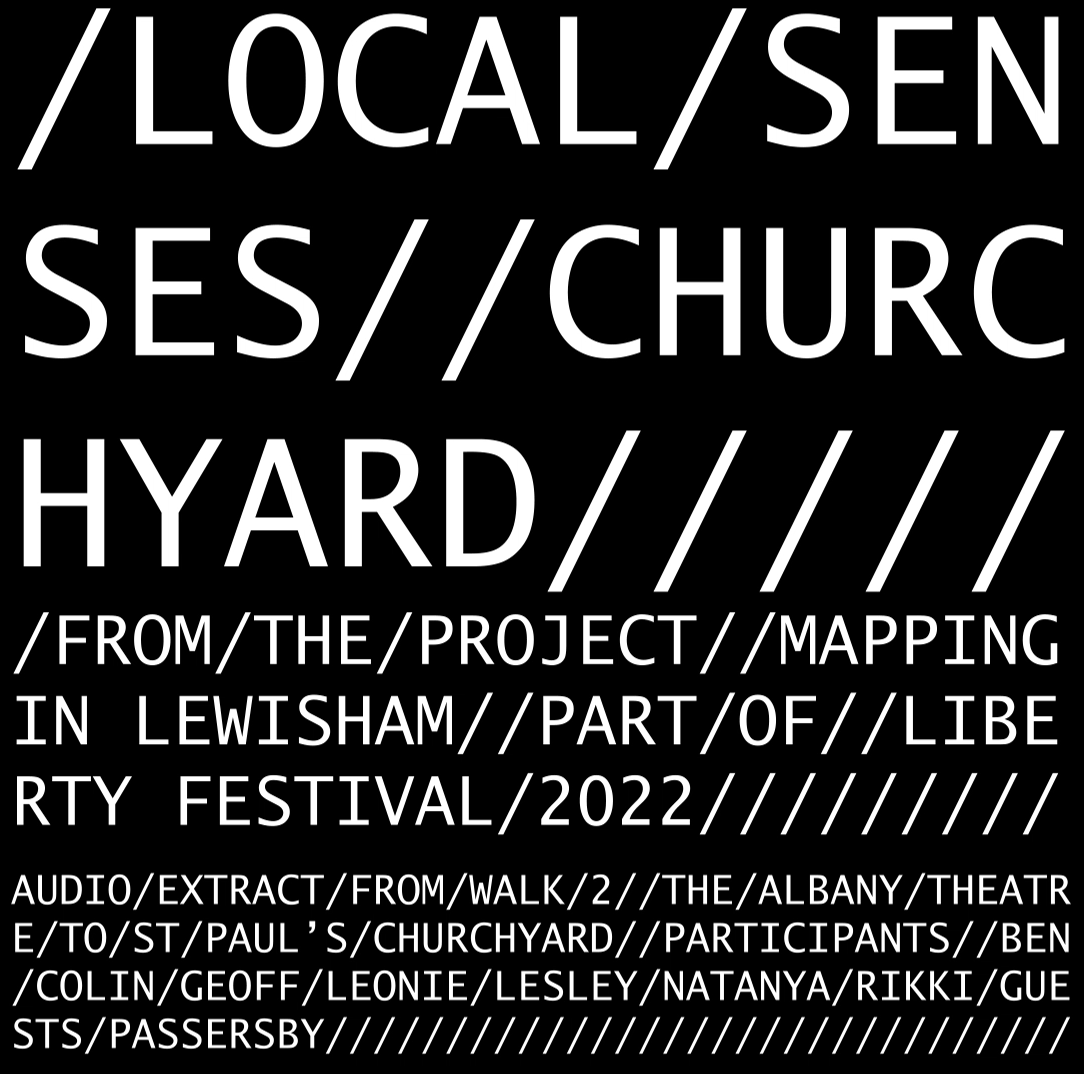
/LOCAL/SENSES//CHURCHYARD/////, polyvocal videography, 2023/24.
These short digital videos are two of eight (one above, one below) made in response to LOCAL SENSES’ participation in Liberty Festival 2022, Deptford, London. The work develops the group’s multi-sensory approach to mapping local environments as a polyvocal listening practice performed through the use of subtitles as a diagram of the exchange.
Each video focuses on the words deployed by the group as they respond to a particular environment or activity beyond the visual. This focus does not seek to make a narrative of this process but rather to hold open the moment of encounter between the group and the environment. As a result, many subtitles appear on screen at once making a conventional reading difficult to achieve. This encourages instead a type of reading that is more like listening, and a type of listening more attuned to the plurality of voices at play. The video also includes the voice of the speech-to-text translation service employed to generate the subtitles (rendered in green), complicating the embodied environment with the environment of translation and reproduction.
For Liberty Festival, LOCAL SENSES shared their poems, music and meditations with both attendees of the festival and local residents. More information on LOCAL SENSES COLLECTIVE can be accessed here:
/LOCAL/SENSES//SAMOSAS////////, polyvocal videography, 2023/24
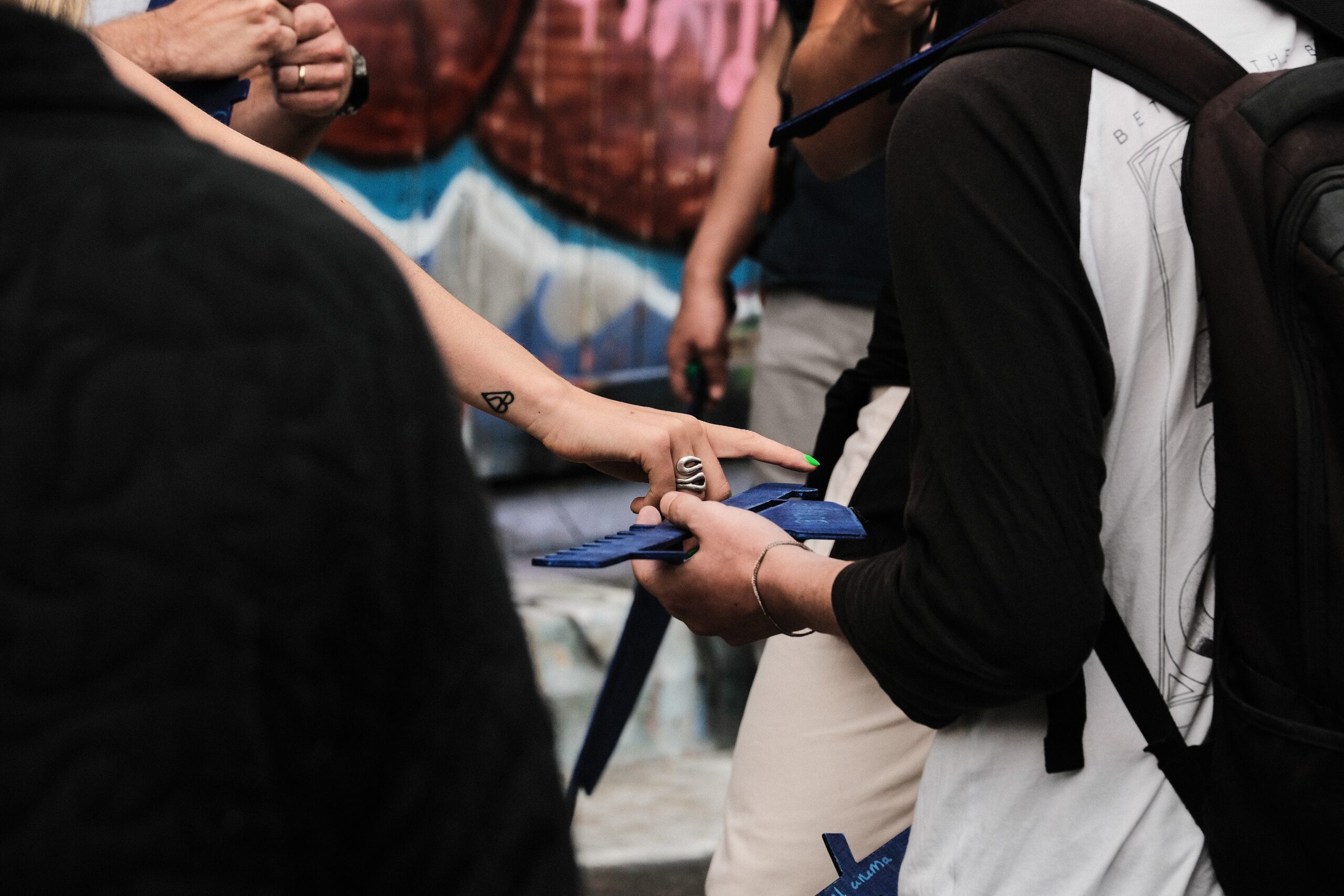
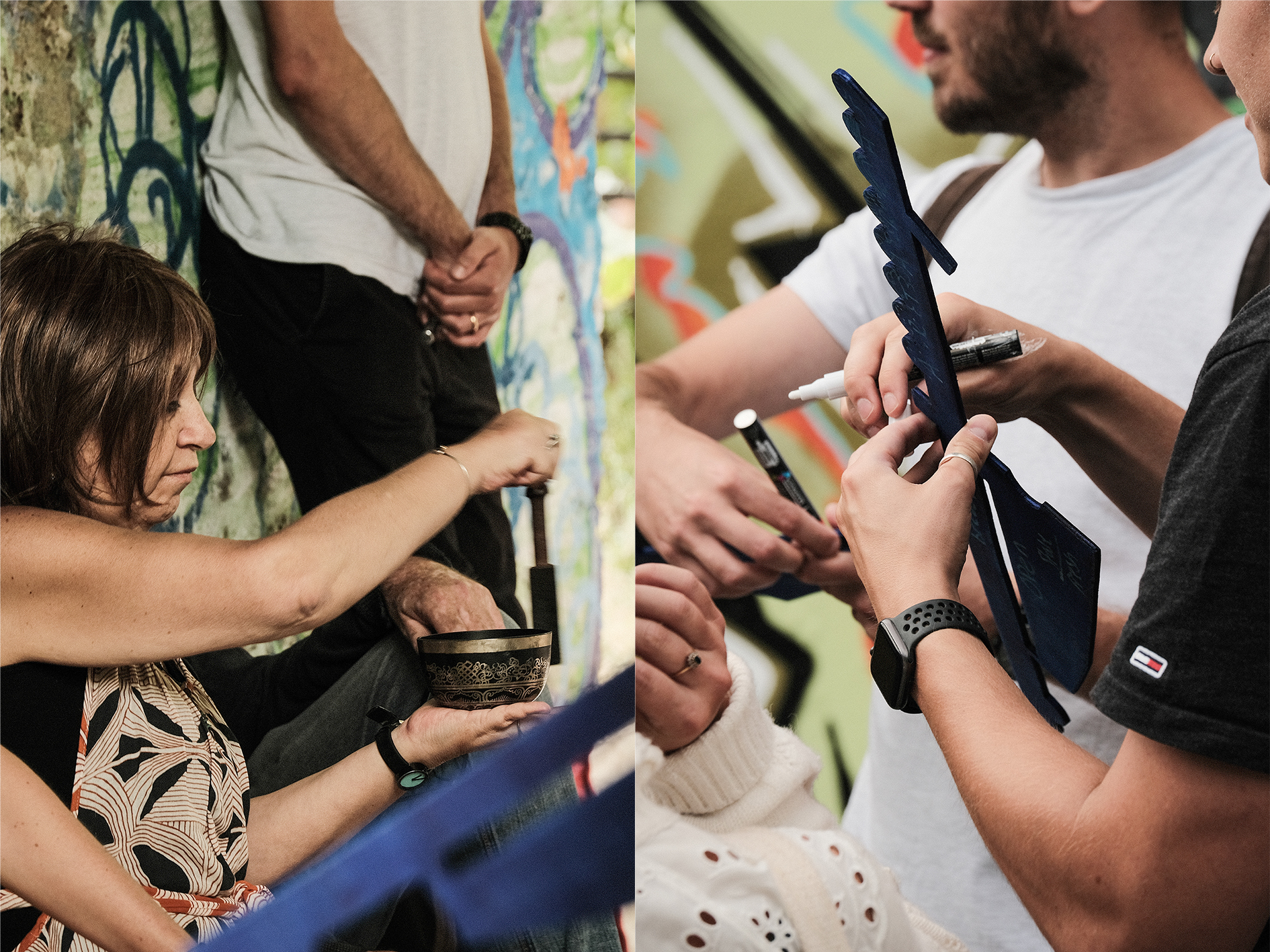
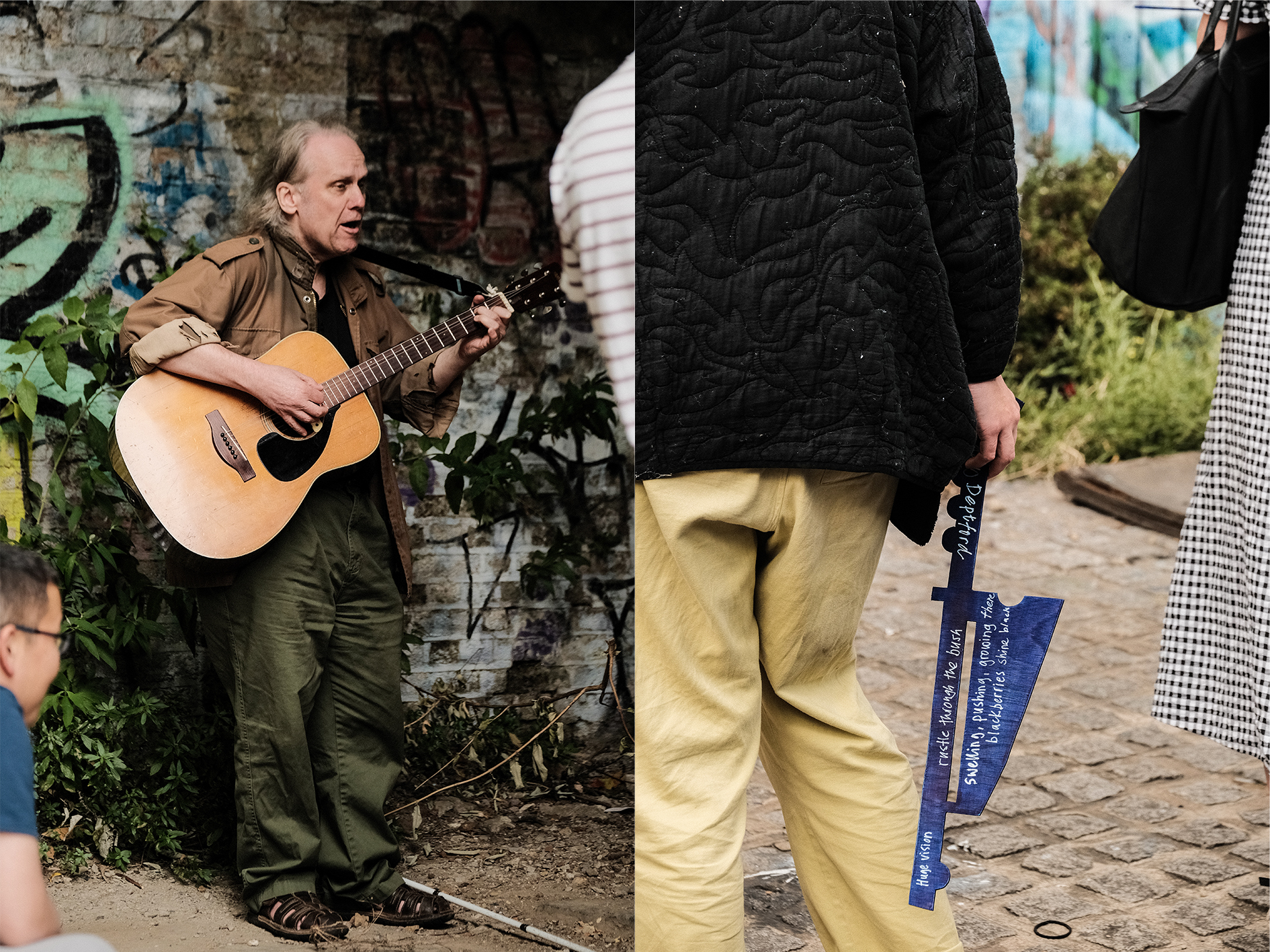
L: Lizzie conducting a meditation under the arches (map in foreground); R: Map marking.
L: Rikki playing “We’re off to the Market”; R: Returning to the Albany from the Creek.
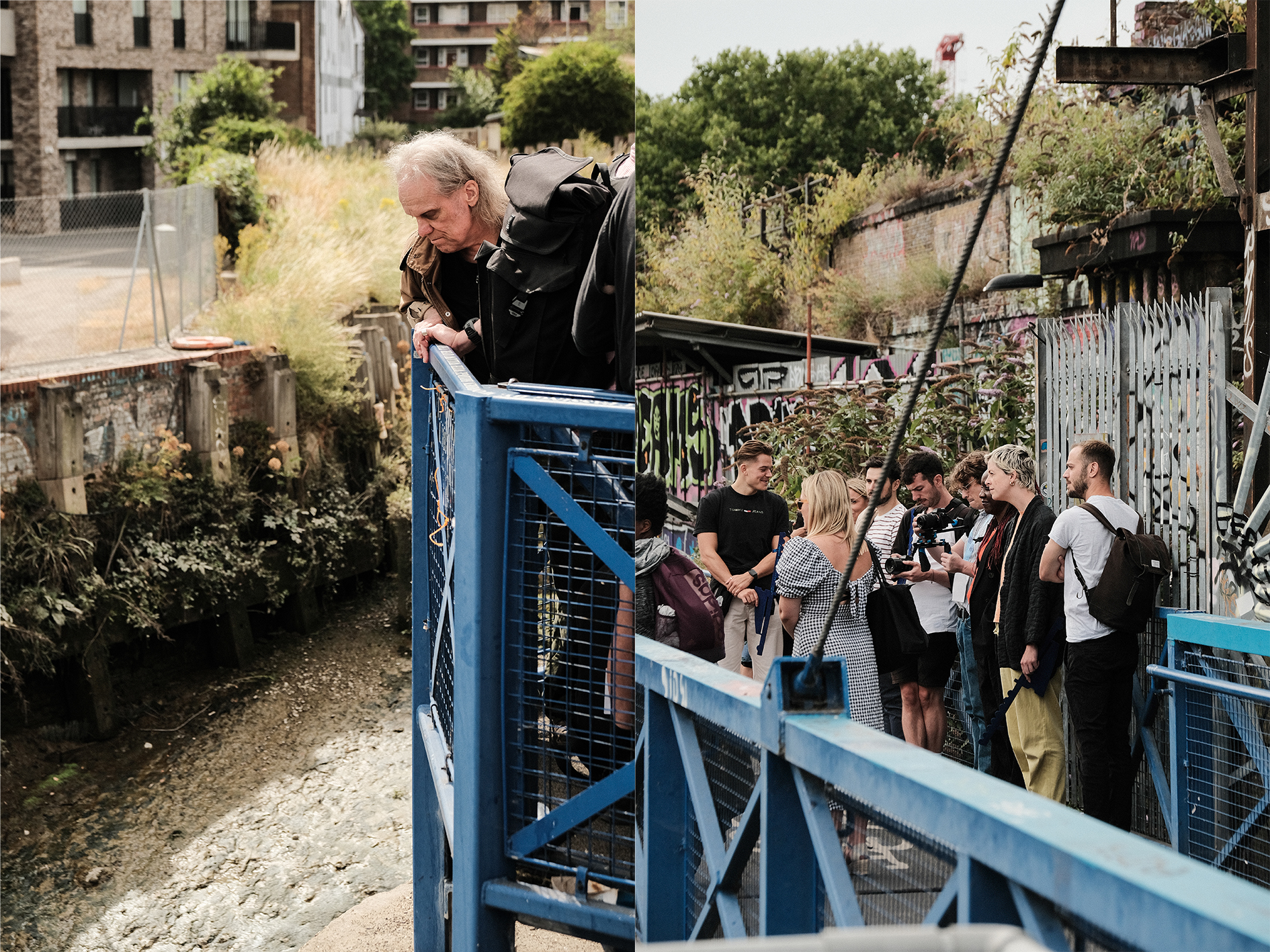
L&R: Sensory Reflection at the Creek
A series of photos documenting Local Senses’ walking workshops shared as part of Liberty 2022. Photography by Miles Perry; composites by Benjamin Jenner.
Local Senses at Liberty Festival Lewisham, July 2022. Documentation of Public Walks for Liberty Festival and London Borough of Culture, Lewisham 2022. Directed by Nathan Bather (Local Senses).
Local Senses Collective – Our Journey
Local Senses Collective are Leonie Abrahamson, Nathan Bather, Geoff Clark, Benjamin Jenner, Rikki Jodelko, Natanya Mark, Lizzie Nichols, Colin Palgrave, and Lesley Palgrave.
The Local Senses collective was formed in 2017 from a series of self-initiated creative workshops. Since then the group has acquired new members, meeting regularly to nurture a sense of community through peer-learning, shared experience and collective discovery.
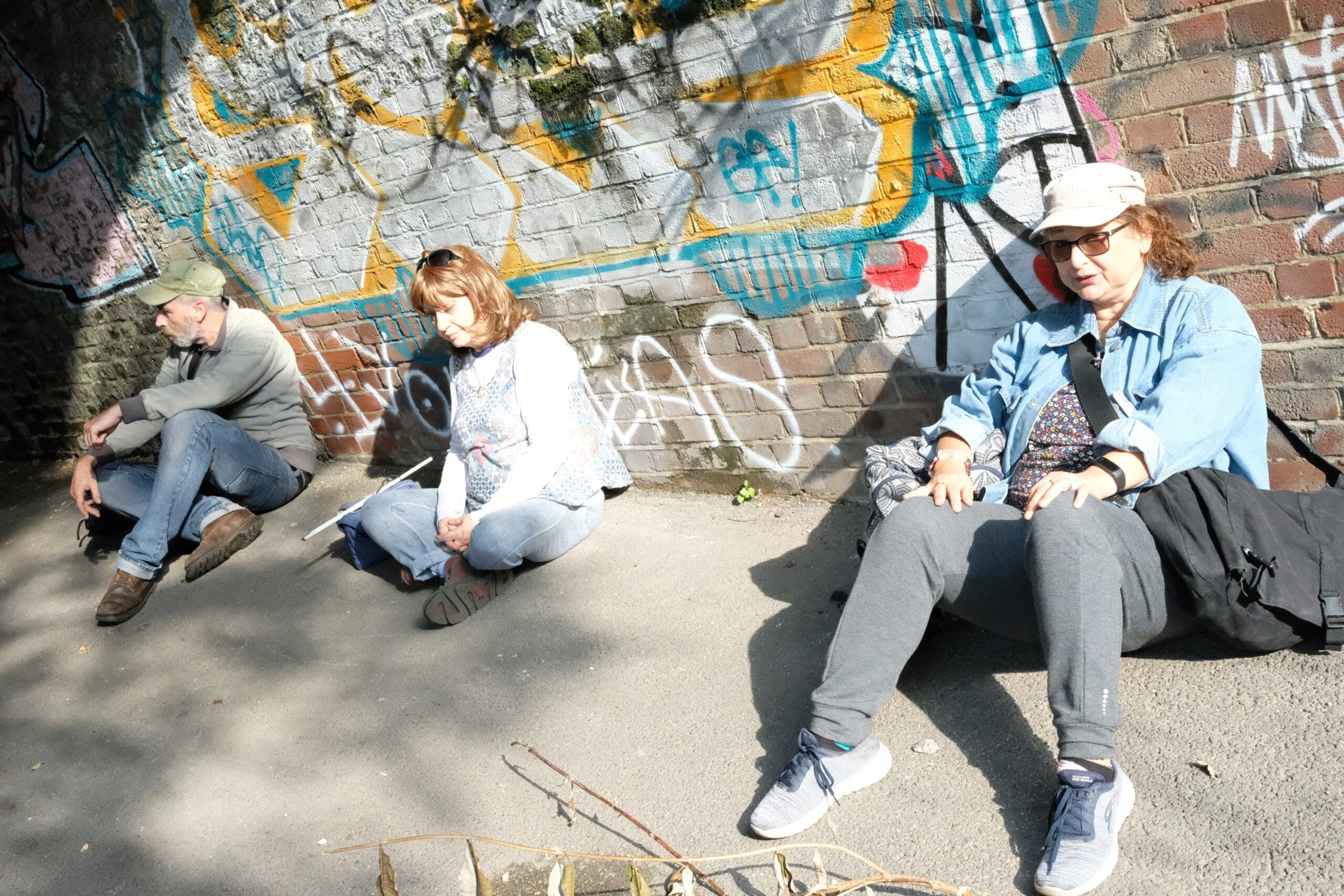
Local Senses members under the arches in Deptford during R&D for Liberty Festival 2022
Since 2019, the collective’s focus has been on generating sensory reflections of the local environment, walking, talking and thinking through the streets, parks, churchyards, play areas, railway arches and creeks that populate that space. Through this process, the collective productively use their individual relationship with vision as a prompt to question the various ways in which a sense of the local might be established. Wondering at the relation between psychic and social space, between what is seen, smelt, tasted, heard or felt with the body, the group question how these sensations might be channelled to effect journeys in the mind.
In order to share this work beyond the group, the collective conduct sensory walks where they re-present their interaction with the terrain through the reading of poems, the playing of songs, the telling of tales, and the handling of alternative cartographies.
Mapping in Lewisham, R&D for Liberty Festival 2022
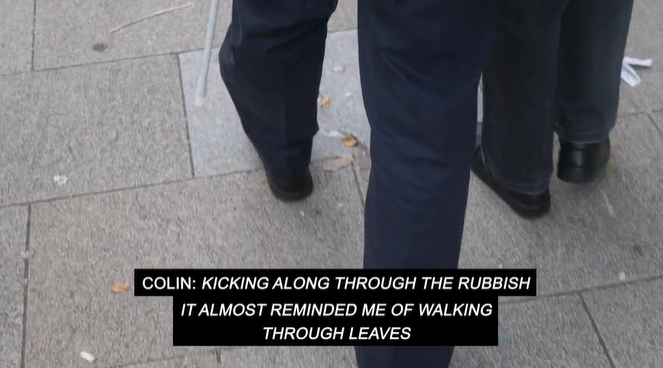
Video still from Liberty Festival R&D documentation. The video is available below.
In the autumn of 2021 LOCAL SENSES secured funding to develop a new body of work for LIBERTY FESTIVAL 2022, an event that took place in the London borough of Lewisham as part of London Borough of Culture 2022.
In January 2022, the group presented the development of their research at a sharing event hosted by the Albany Theater, Deptford. The following invitation was written by LOCAL SENSES for that event:
Tonight, LOCAL SENSES welcomes you to join them on a psychogeographic journey of Lewisham. Via ulterior sensory phenomena the collective will enter your mind and motivate your body in a bid to inspire you to communicate with the local environment beyond the visual. To succeed in this audacious act, they ask you to join them in a period of meditation where you will be led through the local streets towards the water of Deptford Creek. On returning to the room there will be a chance to compose a collection of Haikus and handle locally inspired talismanic forms before heading out to explore the local terrain for yourself. Here, you will join a short walk with musical accompaniment, navigating the area between the Albany and Deptford station. As we walk, we will stop and reflect on the ways in which the environment is shaped by sounds and smells and how this sited information can be captured in language. We will also speculate on the power of the terrain to lead both mind and body beyond themselves, as we move towards previous experiences held in different places and other times. We look forward to welcoming you on this journey with us.
Examples of some of the Haikus, along with other written work, can be seen below:
An audio recording of some of the poems is available here:
This film documents the research and development stage of LOCAL SENSES’ project MAPPING IN LEWISHAM.
LOCAL SENSES: MAPPING IN LEWISHAM 2021 R&D. A film by Nathan Bather.
Mapping in Bloomsbury
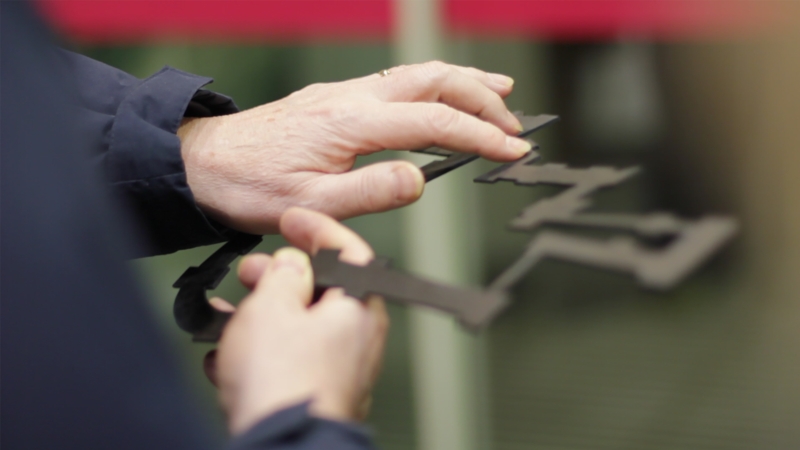
Mapping in Bloomsbury, tactile map in use on route.
In 2019, the group began collaboratively developing strategies for exploring and navigating outdoor space around the Royal National Institute for Blind People. This work was funded by an award from the Mayor of London’s Culture Seeds Fund, and resulted in the publication LOCAL SENSES MAPPING IN BLOOMSBURY, a PDF of which is available to view below:
An audio recording of the book’s content is available here:
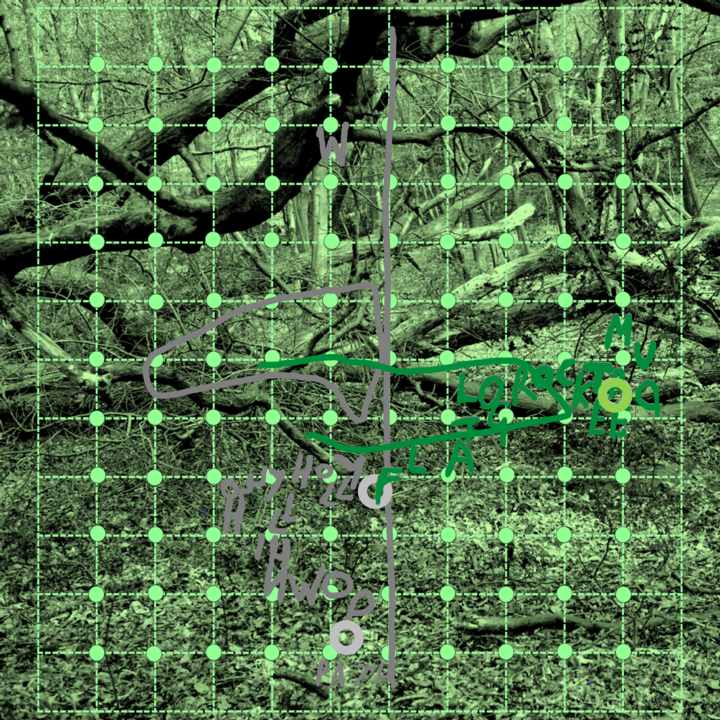
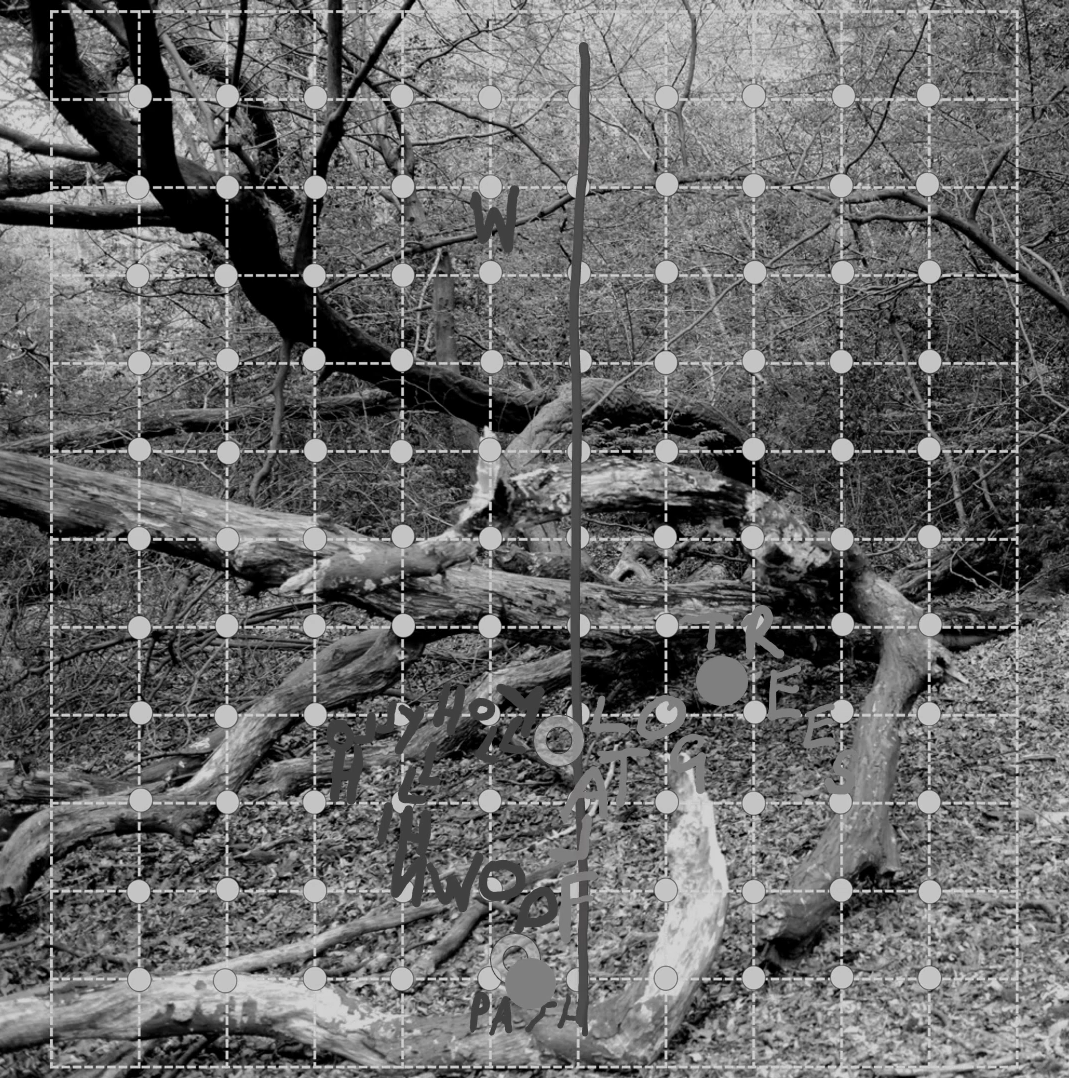
Video still from A Walk in Afternoon Sunshine (available below)
The work listed under “Perceptual Ecology – Forest Work 2” was made as part of my Doctoral Research Project “Embodied Blindfolded Navigation as Perceptual Ecology – The Re-markable Space of Poetic Form” (2019-2023). That project employs non-visuality, in this instance through blindfolding, as a generative constraint, loosening the link between, on the one hand, the time, space and materials of reading and writing, and on the other, the visual and conceptual categories of language. The forest was chosen for its relatively unmarked environmental make-up, enabling greater potential for re-writing experience than, for example, a city space that has more pre-established sensory markers.
Whereas the work categorised under Forest Work 1 is concerned with materialising the disruption to the perceived logic of experience through heightening the strain on mental processing under the prescribed conditions via repetition, prosody and the subversion of expectation; work categorised under Forest Work 2 tries to evidence a response to that overwhelm through the deployment of poetry as a spatial or perhaps even navigational tool.
In Forest Work 2, each forest encounter employs a Robert Grenier drawing poem to assist the rebuilding process, mapping the time and space of the reading and writing experience atop the time and space of moving between the trees. The deployment of Grenier’s coloured letter lines in the forest operate like synesthetic applications, enabling chunks of the experience to be bracketed (Husserl) into discrete units with their own internal logic that is shaped and coloured in relation to the order of the poem. Equally, Grenier’s coloured letter lines disrupt the staves of the page, freeing the letter line up to reappear elsewhere in the forest as brackets overlap and disturb each other (see image below).
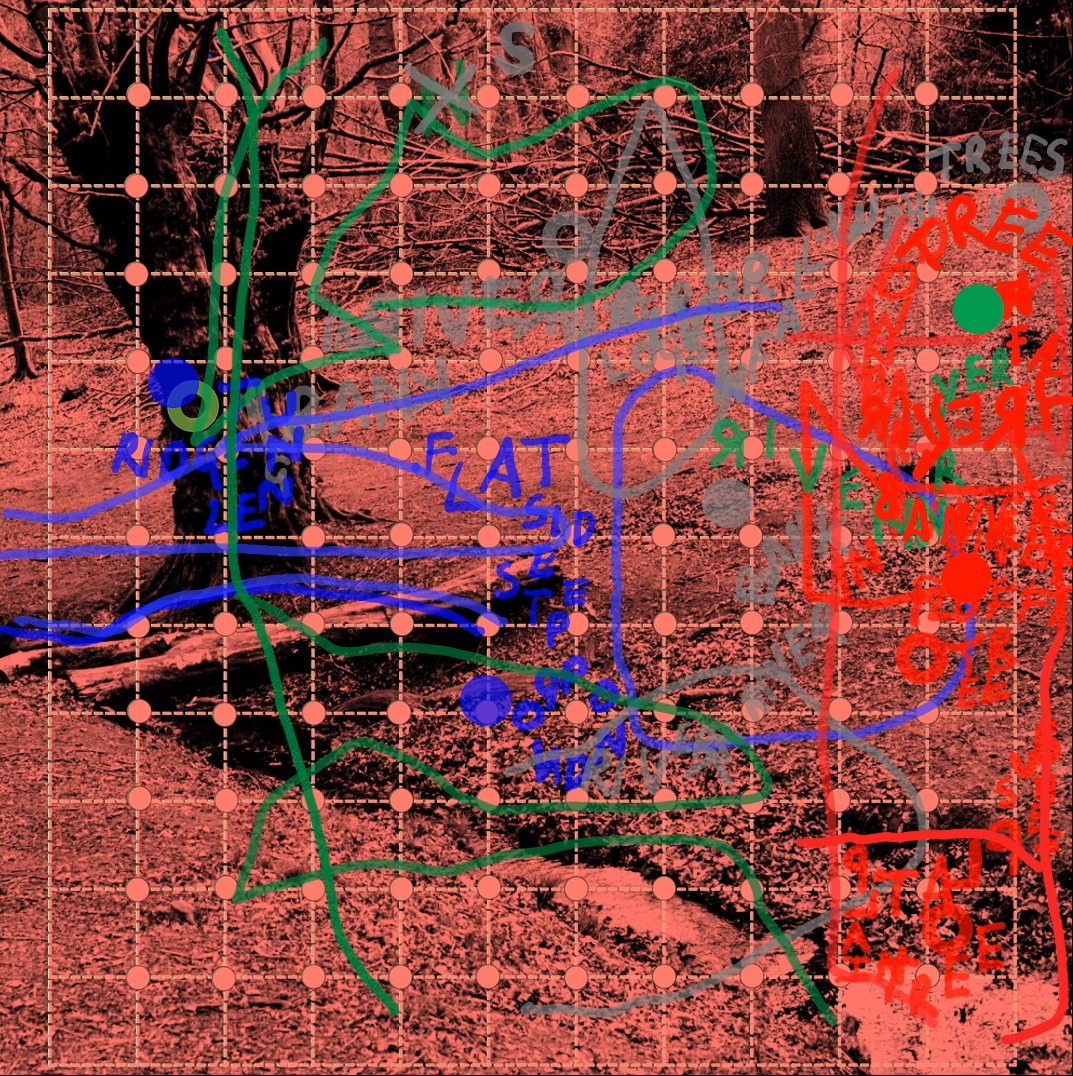
Video still from How Far Away is that Dog? (available below). In this still the larger letters of the Grenier poem can be read as delineating nodes, or clusters of forest observations. In the video, letters and the observations they represent are regularly “picked up” and moved in response to the developing understanding of the space and its qualities.
This process of overlapping is recorded as a “blindfolded word drawing”. These drawings (that begin as pen drawings before being translated into digital animations) are both a diagram of cognising the embodied encounter through the interface of the drawing poem, and a reevaluation of the shape of academic form as a container for non-normative sensory encounters. In this sense, the videographic document, and the writing and reading experience that it enables are intended as an extension of this process.
Work appears below in reverse order – most recent first.
ANOTHER WALK IN AFTERNOON SUNSHINE
Animated re-presentation as digital video with additional environmental sound.
Delivered at EARN (European Artistic Research Network) Gathering, Academy of Fine Arts at University of the Arts Helsinki, Finland, 27-28th October 2022.
A WALK IN AFTERNOON SUNSHINE
A WALK IN AFTERNOON SUNSHINE was shared as part of a performative presentation at the conference Psychosocial Cartographies, held at the Anglo American University, Prague, Czech Republic, 17th & 18th June 2022.
HOW FAR AWAY IS THAT DOG?
DROP ON BUCKEYE TREE
This video formed part of a performative presentation delivered at CPRA (Centre for Practice Research in the Arts), UCLAN (The University of Central Lancashire), 29th April 2022.
Video still from GENERATIVE CONSTRAINT AND THE SITE OF LANGUAGE. LOCATING AN OBJECT THROUGH EMBODIED MUSICALITY IN THE ABSENCE OF VISION (available below).
The work listed under “Perceptual Ecology – City Work” was made as part of my Doctoral Research Project “Embodied Blindfolded Navigation as Perceptual Ecology – The Re-markable Space of Poetic Form” (2019-2023). That project employs non-visuality, in this instance through blindfolding, as a generative constraint, loosening the link between, on the one hand, the time, space and materials of reading and writing, and on the other, the visual and conceptual categories of language.
Made during the Covid–19 lockdowns the City Work films are built around an experience of central London that is rarely, if ever, available now. That is, sounds that would otherwise be absorbed into a larger environmental cacophony remained audible enough to confer the direction of other moving objects, the distance between objects, and the location, size, and shape of obstacles. In the films catalogued below, that environment sound is tuned to the moving body as it charts a course in the absence of vision.
As with the explorations in Forest Work 1 & 2, the work was undertaken alongside a sighted interlocutor. We would dialogue using language that emerged from the activity, impressing on the activity the weak (Vattimo) logic of its own development. Rather than language becoming meaningless through this process, the meaning of language is gradually rebuilt through navigating blindfolded in relation to the specificity of the city site and the temporality of the encounter.
GENERATIVE CONSTRAINT AND THE SITE OF LANGUAGE: LOCATING AN OBJECT THROUGH EMBODIED MUSICALITY IN THE ABSENCE OF VISION. A NAVIGATIONAL AID AS A FILM AS A PRESENTATION was shared as part of the online symposium Vibrant Practices at the University of Leeds on the 16th and 17th April 2021:
https://forkingpaths.leeds.ac.uk/symposium
My abstract from that event is available here:
GENERATIVE CONSTRAINT AND THE SITE OF LANGUAGE. LOCATING AN OBJECT THROUGH EMBODIED MUSICALITY IN THE ABSENCE OF VISION.
This presentation is a fine art, practice-led enquiry. It aims to evidence how environmental sound, dialogic speech and citational practices can be utilised to create a musical, rhythmic, iterative, and prosodic score that doubles as a navigational aid for embodied wayfinding in the absence of vision.
It will interrogate the relationship between composition and sounding through an engagement with embodied cognition, asking how Cagean compositional processes (whose method is largely absent from their sounding), and Reichean compositional processes (whose method usually results in their sounding), affects the status of the resultant audition for the purposes of navigation.
The presentation takes as its material the ephemera from two blindfolded explorations of an urban space conducted under strict generative constraint. The material in question consists of audio, photographic and filmic documentation.
Accounting for the placement of this enquiry at the intersection of non-visual embodied navigation and rhythmic, process-based temporality, any imagery used in this presentation will be bound by two conditions: that it in no way reveals additional information that might benefit a sighted navigator; that it too is subject to the procession of sonic and linguistic iteration by which the work is constructed.
This work is intended for use with headphones.
GENERATIVE CONSTRAINT AND THE SITE OF LANGUAGE. LOCATING AN OBJECT THROUGH EMBODIED MUSICALITY IN THE ABSENCE OF VISION.
TRIPS INTO TOWN, RECORDED ON 11th NOVEMBER 2019 AND THE 29TH OCTOBER 2020.